
- Testosterone commonly raises hematocrit, usually gradually and without symptoms, which is why the test is scheduled rather than symptom-driven.
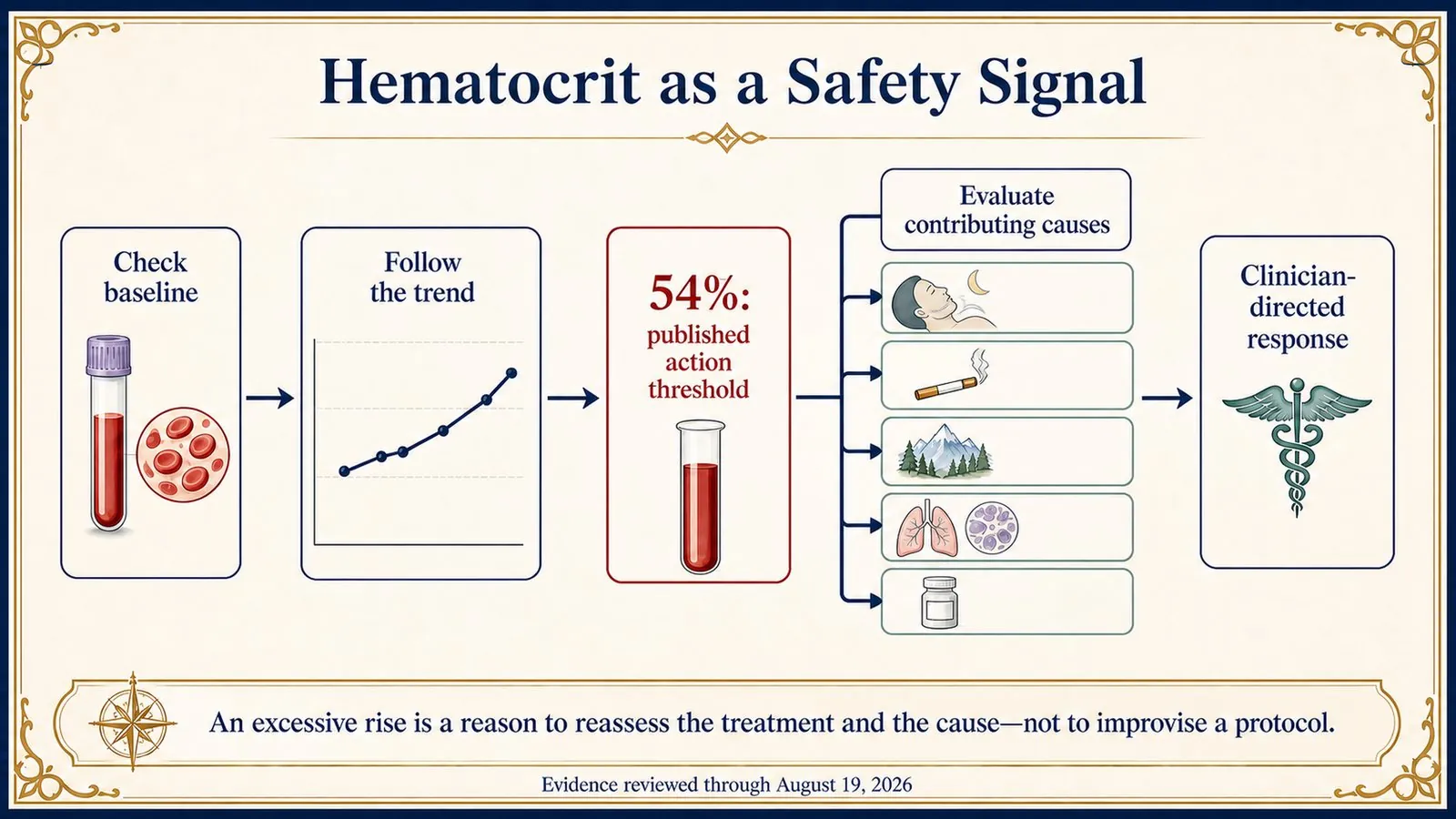
- Guidelines set a hematocrit above 54 percent as the point where treatment must change; I hold to that line and do not invent a lower one.
- Before the line, the trend matters: how fast it rose, whether the product or dose changed, and whether smoking or sleep apnea is contributing.
- Sleep apnea, lung disease, smoking, altitude, kidney or marrow disorders, and undisclosed androgens must be checked, not just the testosterone.
- Donating blood before each test hides the problem, depletes iron, and mimics low-T symptoms; report every donation to your prescriber.
What the numbers describe
You can feel better than you have in a decade and still carry a blood count that obliges me to change your treatment. That is why this test lives on a schedule rather than waiting for a symptom.
Hematocrit is the fraction of your blood, expressed as a percentage, that consists of red blood cells. Hemoglobin is the protein inside those cells that carries oxygen. When there are too many red cells, the term is erythrocytosis, and a climb during therapy does not rule out a marrow disorder or some other secondary cause running alongside. Hematocrit does not measure how thick your blood is or whether it will clot, and no formula converts a percentage into your personal clot risk.
Why the count rises on testosterone
Androgens influence the hormonal and marrow machinery that governs red-cell production, shifting erythropoietin signaling and iron handling. The size of the response varies. A man starting near the top of the range has little headroom, and if low oxygen is already stimulating production, treatment adds to that pressure. The rise is typically gradual and silent; a man notices the extra energy and never senses the count going up.
I treat monitoring as part of the prescription, literally: in my practice the prescription is unfinished until the blood-count schedule sits on the same page as the drug. That framing is mine; guidelines and product labels set their own follow-up expectations. When a baseline is already high, a formulation changes, or a count jumps, I test sooner. What I refuse to do is renew a prescription without knowing the current count. Skipping the test means the drug keeps going while the one safety number most likely to force a decision has gone blind.
Route, dose, and everything else that pushes the count
Network evidence has generally shown bigger hematocrit rises with some intramuscular preparations than with transdermal ones, but formulation is one factor among several. Rates from one population do not carry over to another. The T4DM trial gave a long-acting intramuscular testosterone to men with central obesity and impaired glucose tolerance who did not have pathological hypogonadism; hematocrit went above 54 percent in 22 percent of treated men and 1 percent of those on placebo. That population and that dosing approach do not set the incidence for standard replacement in confirmed hypogonadism.
Testosterone is not the only suspect. Obstructive sleep apnea causes repeated overnight oxygen dips and contributes to secondary erythrocytosis in some men; a rising count paired with witnessed breathing pauses, morning headaches, daytime sleepiness, or stubborn hypertension moves a sleep evaluation to the front of the line. Lung disease, altitude, and smoking reduce oxygen by different routes, and kidney conditions or primary marrow disorders such as polycythemia vera require their own workup. Testosterone from a second source and undisclosed performance-enhancing drugs also belong in the review.
The 54-percent line
I did not invent this number. The major urology and endocrine guidelines identify a hematocrit above 54 percent as the point at which treatment must change, and I hold that line because I have watched men rationalize their way past it one point at a time. What happens once a patient crosses it depends on the man. The guidelines permit holding the drug, reducing exposure, or removing blood when there is a reason to. Writing the next refill and hoping the count drifts down is not among the options. A strong symptom response does not buy an exemption.
The threshold does not claim 53.9 percent is proven safe and 54.1 abruptly hazardous. Below the line I watch the trend: how far the count has moved from baseline and over how many months, whether the route or dose changed shortly before the climb, whether he smokes or snores, and whether a recent blood donation is masking the true peak. I have no lower number at which I act, and I will not fabricate one. But a count nearing 54 on a steep trajectory in a high-risk man gets his exposure and other causes reviewed before the line is reached.
Ory and colleagues published an observational comparison of 5,842 men on testosterone whose hematocrit reached at least 52 percent against 5,842 matched men whose did not. The rate of major adverse cardiovascular events or venous thromboembolism was 5.15 percent in the first group and 3.87 percent in the second, an odds ratio of 1.35. That result justifies concern without establishing cause, and the 52-percent research definition should not be swapped in for the guideline's above-54 action point.
The blood bank is not a monitoring plan
A man who donates blood ahead of every lab draw shows me a comforting hematocrit while the driver of the rise carries on unchanged, and I lose the information needed to judge whether his regimen is sustainable. Scheduled phlebotomy can be legitimate treatment in selected situations, not routine upkeep for a regimen that keeps regenerating the problem. Repeated blood removal also drains iron, and iron deficiency brings fatigue, reduced exercise capacity, and restless legs, all easily mislabeled as "the low T coming back." Every donation and phlebotomy, with its date, should reach the prescriber.
Sudden breathlessness, chest pain, fainting, or a painful swollen leg gets urgent evaluation, never a wait for a repeat count. A climbing hematocrit is a prompt to look harder, not a sentence, and no benefit excuses a safety signal left unmanaged.
Common questions
What hematocrit level is too high on testosterone?
The major urology and endocrine guidelines identify a hematocrit above 54 percent as the point at which treatment must change, whether by holding the drug, reducing exposure, or removing blood when indicated. I did not set that number, but I hold the line. It does not mean 53 percent is safe; a count rising steeply in a high-risk man gets his exposure and other causes reviewed before the threshold is reached.
Can I just donate blood to lower my hematocrit on TRT?
No. Donating ahead of every lab draw produces a comforting number while whatever is driving the rise carries on unchanged, and your prescriber loses the information needed to judge whether the regimen is sustainable. Repeated blood removal also drains iron, and the resulting fatigue and reduced exercise capacity are easily mistaken for low testosterone returning. Report every donation, with its date, to your prescriber.
Why does testosterone raise red blood cell counts?
Androgens influence the hormonal and marrow machinery that governs red-cell production, shifting erythropoietin signaling and iron handling. The size of the response varies, and a man who starts near the top of the range has little headroom. Sleep apnea, smoking, lung disease, and altitude add their own push, so a rising count triggers a search for other causes rather than a look at the testosterone alone.