
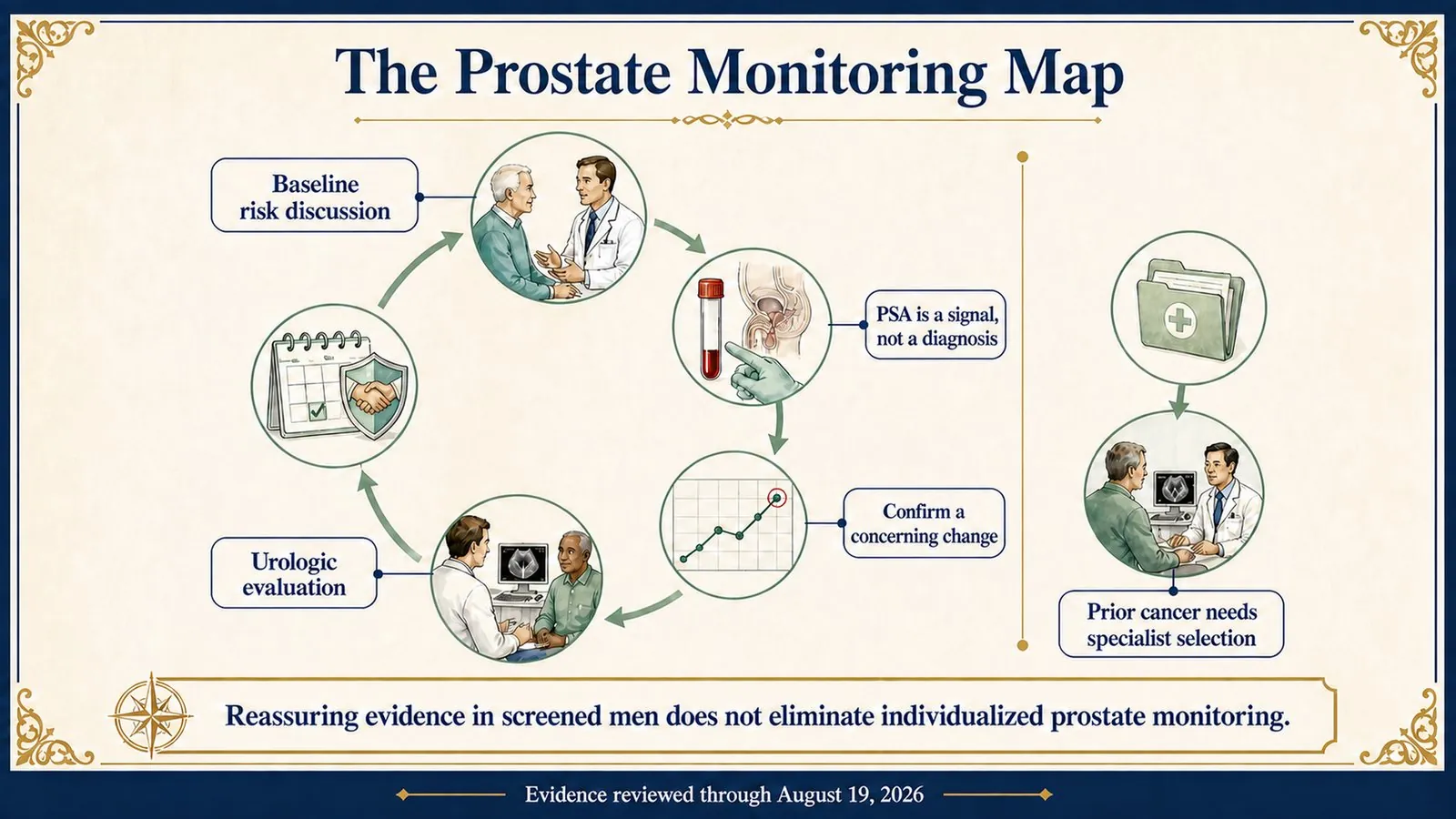
- PSA is a prostate signal, not a cancer test: a rise does not diagnose cancer and a stable value does not exclude it.
- An abnormal baseline PSA or severe urinary symptoms get evaluated before testosterone starts, not after.
- Past age fifty, I check PSA about every six months on treatment so it becomes a trend; that is my practice, not a guideline requirement.
- The TRAVERSE prostate analysis was reassuring in carefully screened men but excluded anyone with PSA above 3.0 or severe urinary symptoms.
- Active or recurrent prostate cancer stays outside routine TRT; selected survivors with a controlled, stable PSA may be considered with the oncology team involved.
A PSA number is a signal from the gland, not a verdict
A man's PSA was 2.1 before he started, the first recheck reads 3.0, and he arrives with the number circled and an arrow pointing upward, asking whether the treatment planted a cancer. My answer is that PSA reports on the prostate, and the prostate has many reasons to release it. Benign enlargement, prostatitis, infection, urinary retention, a recent procedure, day-to-day variation, and malignancy can all move it. Feeling well cannot tell those apart, and the result still has to be confirmed and evaluated according to risk.
Two opposite myths surround this topic: that any testosterone exposure feeds a hidden tumor, and that modern trials have made the prostate irrelevant. The evidence supports a middle path: choose patients carefully, document baseline risk, monitor by current guidance, act on meaningful change, and route cancer survivors to a narrower specialist track.
PSA is a protein from prostate tissue, and no isolated value diagnoses cancer or safely rules it out. Direction and pace over time matter far more than one flagged portal result, and an unexpected reading usually earns a repeat before anyone contemplates a biopsy. Repeating is not dismissing; it is how you avoid deciding on noise. A urology referral, likewise, is an investigation rather than a diagnosis.
Why I want the prostate history first
Before treatment I gather earlier PSA results, any biopsies or imaging, prior infections or procedures, current prostate medicines, family history, and any personal cancer history. If the baseline is abnormal, it gets worked up first. Once testosterone is on board, a later change can no longer be sorted into natural progression, a treatment-related prostate response, or a process already underway. Holding a prescription while a genuine signal is evaluated is diagnostic care, not refusal.
Men with low testosterone can show a modest PSA increase once androgen exposure is restored, and prostate tissue responds to that. That expected response does not make every rise benign. On the interval itself, I go beyond the guideline minimum and I say so openly: for men over fifty on treatment, I recheck PSA roughly every six months instead of annually. A yearly schedule that follows the guidelines is appropriate practice; the twice-yearly check is my preference, because only a series of points becomes a trend, and a trend is the only useful thing PSA produces. What I refuse to do is turn PSA into a cancer test in either direction: an increase does not prove cancer, and a flat value does not exonerate a man.
Urinary symptoms deserve their own work-up
Lower urinary tract symptoms cover frequency, urgency, nighttime urination, a weak or hesitant stream, straining, incomplete emptying, and leakage. Benign prostate enlargement is a common cause, but bladder dysfunction, diabetes, sleep apnea, diuretics, and infection can look identical. Severe symptoms need evaluation before any hormone is started. Controlled trials in carefully selected men have not found a large average worsening of urinary symptoms, but they generally kept men with severe baseline symptoms out, so I measure urinary change after treatment rather than assuming it.
The TRAVERSE prostate substudy
The prespecified prostate analysis within TRAVERSE randomized 5,204 men to testosterone gel or placebo and accumulated roughly 14,304 person-years of adjudicated follow-up. Entry criteria were tight: a PSA over 3.0 nanograms per milliliter or an International Prostate Symptom Score over 19 kept a man out. High-grade prostate cancer was found in five of 2,596 men on testosterone versus three of 2,602 on placebo. The hazard ratio of 1.62 carried a 95 percent confidence interval from 0.39 to 6.77, which comfortably contains no difference. Other adjudicated prostate events were rare and similar between arms, although PSA did climb more with testosterone.
For screened men over the years studied, that is reassuring, but prostate cancer unfolds over a much longer horizon than the trial, so monitoring continues. The substudy argues for selection, not against it; quoting the low event rate while discarding the safeguards inverts its lesson.
After prostate cancer, a narrower question
None of that covers a man already treated for prostate cancer. Active, recurrent, metastatic, or otherwise uncontrolled disease sits outside routine replacement, and no one should override an oncology plan with testosterone sourced elsewhere. My position on survivors is firm: a prior prostate cancer does not permanently close the conversation. For carefully chosen men who have completed definitive treatment for localized disease, whose cancer looks controlled, and whose PSA has remained appropriately low and steady, I may consider therapy after a fully informed discussion with his oncology team. When the PSA hints that disease may still be active, the cancer takes priority and testosterone waits. This is my practice rather than a guideline mandate, and for some survivor groups the supporting evidence is thin.
The 2026 SPIRIT randomized trial studied 136 symptomatic hypogonadal men after radical prostatectomy for organ-confined, low-grade cancer, each with an undetectable PSA for at least two years. Across twelve weeks, neither arm had a biochemical recurrence. That is real short-term randomized data, not proof of long-term oncologic safety. The 2026 European Association of Urology guideline offers a weak recommendation for carefully selected low-risk men after surgery, contingent on at least one year of follow-up with PSA under 0.01 ng/mL and no sign of recurrence.
Finally, every PSA result needs a named owner: who orders it, who reads it, and who calls the patient.
Common questions
Does testosterone therapy cause prostate cancer?
Neither myth holds up. In the screened population of the TRAVERSE prostate substudy, high-grade cancer appeared in five of 2,596 men receiving testosterone and three of 2,602 receiving placebo, and the confidence interval around that comparison is wide enough to include no effect at all. Because men with a PSA over 3.0 or severe urinary symptoms were excluded, and because prostate cancer takes many years to develop, ongoing monitoring stays in place.
My PSA went up on TRT. Does that mean cancer?
Not by itself. Benign enlargement, inflammation, infection, a recent examination or procedure, and ordinary variation all raise PSA, and a modest rise is expected in hypogonadal men once androgen exposure returns. What I do with a surprising value is repeat it, interpret it against your baseline and prostate history, and refer for urologic evaluation if the picture warrants it.
Can I take testosterone after prostate cancer?
If the cancer is active, recurrent, or metastatic, routine replacement is off the table. For selected men who have had definitive treatment for localized disease, with a cancer that appears controlled and a PSA that has stayed low and stable, I may consider therapy after an informed conversation with the oncology team. Any PSA pattern suggesting live disease means the cancer comes first.