
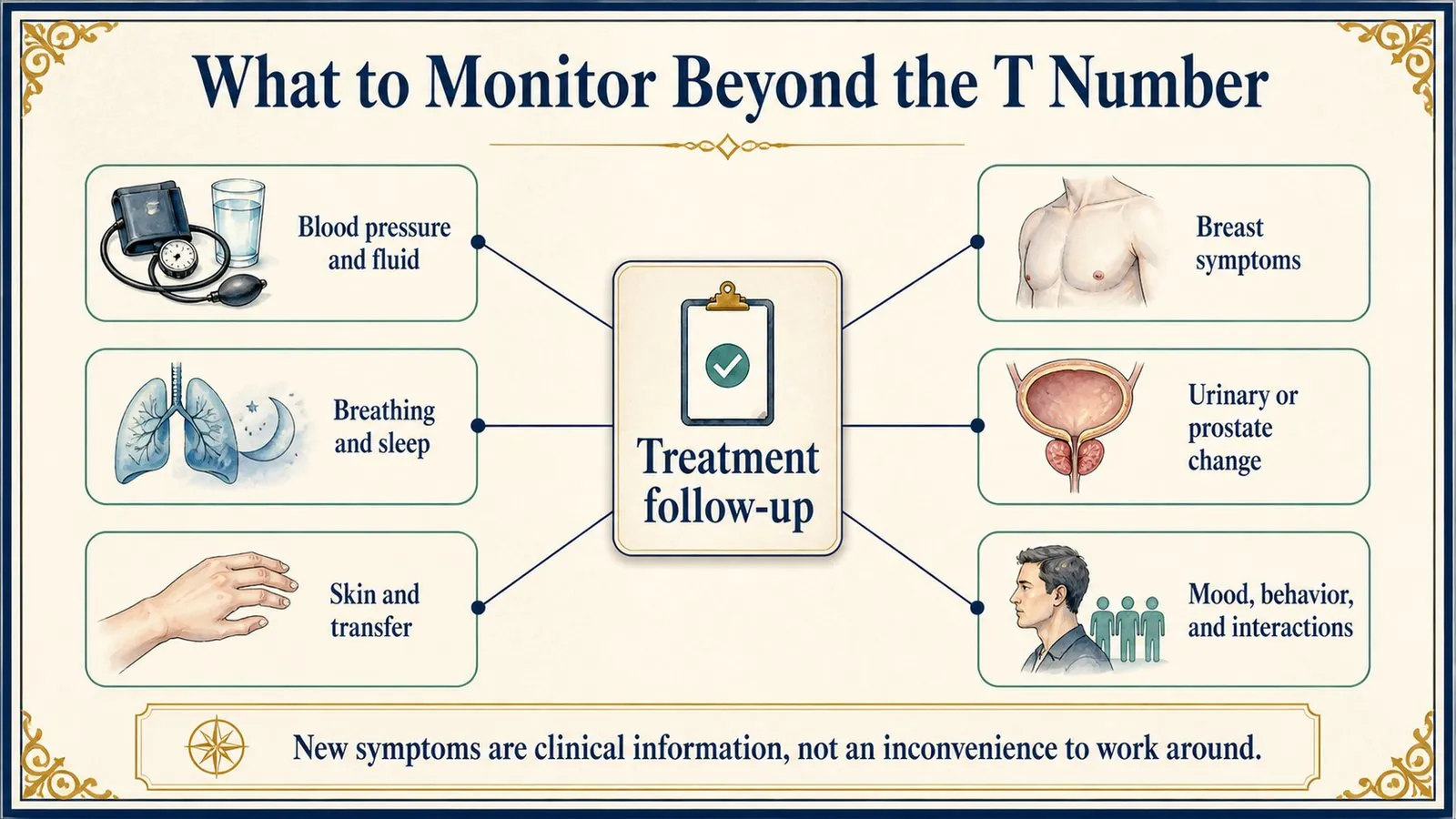
- A normal testosterone level does not rule out worsening sleep apnea, fluid retention, breast changes, or a mood shift; new symptoms are treatment data.
- Testosterone can worsen sleep-disordered breathing in susceptible men, and the partner in the bed usually notices first.
- Topical testosterone can transfer to partners and children; cover the site and wash before contact, every time.
- Testosterone is not an antidepressant, and new agitation, aggression, or risk-taking needs prompt attention as much as low mood does.
- For any new symptom: what changed, when relative to treatment, what else explains it, and how serious could it be.
The man who feels great is the one I watch closest
At a three-month follow-up the patient is happy: his sexual interest has returned. His wife beside him is not; the snoring is louder, and she has been counting the pauses in his breathing. Something new on treatment is information about the treatment, not a loyalty test. A testosterone level in range excludes none of these signals, which is why the man who feels better and wants to wave everything else away needs monitoring that looks past the number.
Sleep apnea
In obstructive sleep apnea the airway repeatedly narrows during sleep, oxygen dips, and rest fragments. Its consequences, fatigue, low mood, sexual dysfunction, resistant hypertension, and a lower measured testosterone, mean men sometimes request testosterone for symptoms the sleep disorder is causing. Professional guidance flags untreated severe apnea as a major caution, and current labeling states that testosterone may potentiate sleep apnea in some patients, especially with obesity or chronic lung disease. My habit, beyond what guidelines require, is to ask about sleep at every visit. The bed partner is usually the first to notice louder snoring, witnessed pauses, gasping, morning headaches, or daytime sleepiness. A reassuring testosterone level is never my answer to a sleep question.
The evidence includes a randomized trial by Hoyos and colleagues in 67 obese men with severe apnea, who received a long-acting intramuscular testosterone or placebo alongside a weight-loss program. At seven weeks the testosterone arm showed a worse oxygen-desaturation index, roughly 10.3 more events per hour, and about 6.1 percentage points more sleep time at low oxygen. By eighteen weeks those gaps had disappeared. The safe conclusion: testosterone can aggravate sleep-disordered breathing in susceptible men, and an old apnea diagnosis is not the same as effective treatment now.
Skin, household transfer, and breast tissue
More androgen means oilier skin, and acne can surface on the face, chest, shoulders, or back. Mild breakouts are manageable; abrupt severe inflammation or scarring needs attention, and a skin change sometimes points to higher exposure or an undisclosed androgenic product. Application-site reactions get solved under supervision, not by moving the product to unapproved skin.
The skin is also a route to other people. Leftover topical testosterone moves through skin-to-skin contact and can reach a woman or a child, with potentially serious virilizing effects. The labels require covering the site and washing before expected contact. A child or partner who develops early puberty-like changes or new body hair needs prompt medical attention. No benefit to the man himself justifies an exposure to someone else that could have been avoided.
Part of any testosterone dose is converted to estradiol, and in some men the balance between androgen and estrogen signaling produces breast tenderness or gynecomastia. One estradiol value is not a ratio that generates another prescription. A firm or fixed lump, nipple discharge, skin change, enlarged lymph node, or a progressive one-sided finding requires clinical evaluation, because male breast cancer is rare but real.
Fluid
Androgens cause some men to retain sodium and water. Swollen ankles, rapid weight shifts, tight rings, or new shortness of breath are early signs, but heart, kidney, liver, and medication-related disease look identical. Labeling warns that edema, whether or not heart failure is present, can become a serious complication when cardiac, renal, or hepatic disease already exists. Rapid swelling is never explained by lean-mass gains. Fast-worsening breathlessness, chest symptoms, fainting, or pronounced one-sided leg swelling calls for urgent assessment rather than a borrowed diuretic or a self-adjusted dose.
Mood, in both directions
Low mood, irritability, poor concentration, and broken sleep accompany hypogonadism, but depression, anxiety, bipolar illness, substance use, medication effects, and sleep apnea all produce the same picture. Testosterone does not replace a mental-health assessment, and I never promise it will lift anyone's mood. The prespecified TRAVERSE mood analysis covered 5,204 participants, including 2,643 with a Patient Health Questionnaire score above 4; it found small average gains in mood and energy, nothing for sleep or cognition, and no benefit among the 49 men who met a strict definition of persistent depressive disorder, a subgroup too small to be conclusive. Testosterone is not an established antidepressant, and it should not postpone evidence-based depression care.
I also watch for movement the other way. New agitation, pronounced irritability, impulsivity, insomnia, racing thoughts, aggression, or uncharacteristic risk-taking deserves prompt attention; it can reflect excessive exposure, an emerging mood disorder, substance use, or sleep deprivation. Men often feel heightened drive as improvement while those around them see loss of control, so the partner's report matters. Suicidal thinking or dangerous behavior is an urgent evaluation, not a wait for the next lab.
Sexual changes, hidden exposures, and four questions
Weaker erections are not a reason to raise the dose; desire can climb while vascular erectile dysfunction persists. A painful, prolonged erection is an emergency. If plans for children change, the prescriber needs to hear it right away, and nonprescription "test boosters" and anabolic agents must be disclosed, because no adverse signal can be read while part of the exposure is concealed.
For any new symptom I work through four questions: what has changed, how its timing relates to treatment, what else could account for it, and how serious it might be. They guide assessment, not self-treatment. Mild effects get a plan, serious ones get prompt care, and emergencies skip the routine visit altogether.
Common questions
Can testosterone therapy make sleep apnea worse?
It can, in men who are susceptible. The current label warns that testosterone may potentiate sleep apnea, particularly with obesity or chronic lung disease, and a randomized trial in obese men with severe apnea found worse nighttime oxygen drops at seven weeks, a difference that had faded by eighteen weeks. If snoring gets louder or a partner notices pauses, or if morning headaches or daytime sleepiness appear after starting, report it for evaluation rather than letting a good level explain it away.
Does TRT cause acne, and is testosterone gel dangerous to my family?
Both are real. Extra androgen increases skin oil and can bring acne to the face, chest, shoulders, or back; mild cases are manageable, while severe inflammation or scarring needs attention. Gel residue passes through skin contact and can virilize a woman or child, sometimes seriously, which is why the label tells you to cover the site and wash before contact. Those precautions exist for the people in your household.
Will testosterone improve my mood or depression?
I make no such promise. The TRAVERSE analysis found small average improvements in mood and energy in men with confirmed hypogonadism, no improvement in sleep or cognition, and no benefit in the small group with persistent depressive disorder. Testosterone is not an established antidepressant, and evidence-based depression care should never wait on it.