
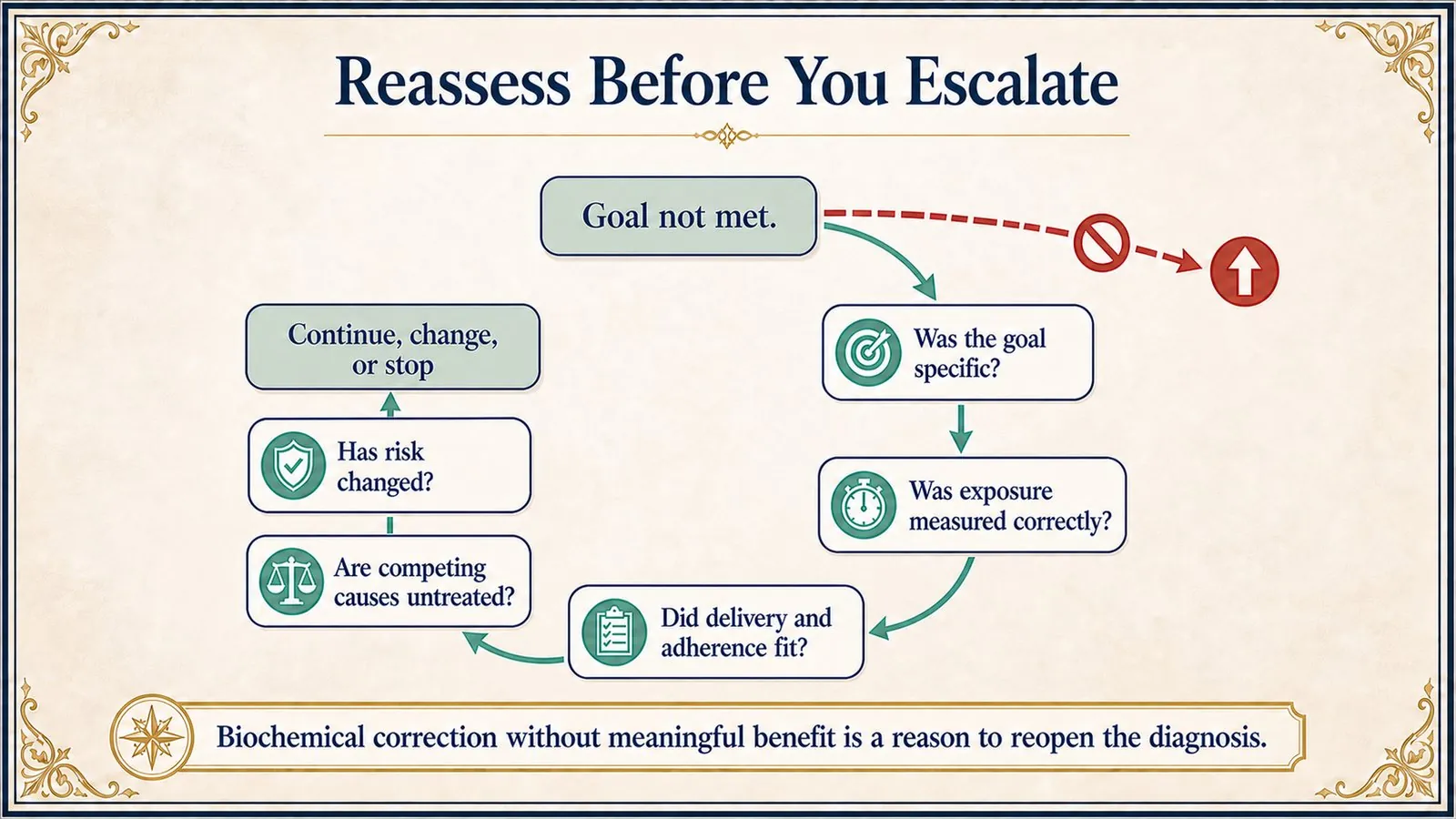
- "Not working" has several possible meanings: an unmet goal, uneven exposure or mistimed sampling, real-world use that differs from the chart, a side effect canceling the benefit, or an incomplete original diagnosis.
- A structured review comes before any change in exposure; raising the dose first can add hematocrit, blood pressure, sleep apnea, mood, and fertility harms while the real cause goes untreated.
- The review runs back to the diagnosis and the written goal, then exposure and measurement, then actual use, then competing causes, then safety, and only then a supervised decision to continue, change, pause, or stop.
- Dr. Shusterman's established-treatment range is roughly 500 to 900 ng/dL, drawn at a formulation-appropriate point; he will not push past it because an online screenshot called a result unoptimized.
- Escalation is not a diagnosis. A stack of add-on medicines built to rescue the first prescription cannot be interpreted, and a second opinion should arrive with the full record rather than restart the escalation loop.
Several failures hide behind one complaint
Eight months in and still exhausted, a man shows me a forum thread flagging his result as "not optimized." He wants more. I want to know what he expected the treatment to fix, and whether that ever moved.
"It isn't working" can describe very different situations. Perhaps the target symptom never budged. Perhaps the product delivered uneven exposure, or the blood draw landed at the wrong point in the dosing cycle. Perhaps real-world use differs from the chart, a side effect cancels the benefit, or the fatigue was never androgen-driven. Each of those calls for a different decision, and a higher dose answers none of them.
Escalating first has costs: hematocrit and blood pressure can climb, swelling and sleep apnea can worsen, mood can destabilize, fertility suppression deepens, and the true cause goes unexamined. So I review before I alter exposure.
Start with the original claim
What did we agree testosterone would change? If the recorded goal was desire and desire never improved, the answer is a clear no. If the goal was to "feel optimized," nothing stable exists to judge against, and the man remains on treatment indefinitely with no rule for stopping.
A written baseline matters because recollection drifts over months of therapy. I also separate the goal into parts: desire versus erection rigidity, energy versus exercise capacity, mood versus memory, body composition versus scale weight. And when a brief improvement fades back to the old level, that is usually regression toward the mean, not evidence that tolerance has set in and exposure has to rise.
Was the diagnosis sound?
I confirm that the diagnosis rested on compatible symptoms and two properly drawn low morning values. If it rested on a single afternoon sample, apparent nonresponse may be revealing a foundation that was never solid. One screenshot is not a diagnostic record.
I also ask whether some reversible contributor was meant to be addressed alongside testosterone and then dropped: untreated sleep apnea, advancing weight-related illness, an opioid still holding the axis down, continuing severe caloric restriction. New illness can emerge after a valid diagnosis, too, and treating every return of symptoms as testosterone "wearing off" risks delaying the evaluation of something more serious.
Measure exposure before judging response
Every formulation traces its own concentration curve. Draw near the peak and the result looks fine while the man spends most of the week low; draw at the trough and the number invites escalation when overall exposure is adequate. Without product, timing, and treatment history, a lab report cannot be read.
For a man established on therapy, my target is roughly 500 to 900 ng/dL, sampled at the point in his formulation's cycle that represents his usual exposure. That is my preference rather than a guideline requirement. I will not chase a value beyond that range because someone's screenshot labeled his result unoptimized. Treat the man, not the number.
An adequate level shows only that the drug reached the bloodstream. Too much exposure can itself masquerade as failure: disrupted sleep, mood swings, edema, rising blood pressure, acne, or erythrocytosis can leave a man tired and on edge with a high number.
How the medicine was really used
Skipped applications, late injections, travel gaps, and cost-driven interruptions are common, and men conceal them for fear of judgment or losing the prescription. I need the real pattern of use, assembled without blame, because adherence is clinical data rather than a confession. A "booster" added in a rough week produces exposure I cannot interpret. And when adherence is poor because the burden outweighs the benefit, the honest conclusion may be that this therapy does not fit this man.
The explanations testosterone cannot fix
Persistent fatigue needs a wide differential. Sleep that is short or fragmented, obstructive apnea, depression and anxiety, anemia, thyroid disease and diabetes, cardiac or pulmonary disease, chronic infection, pain, overtraining or undernutrition, alcohol, and sedating medications can each contribute. Erectile difficulty usually stems from vascular, neurologic, pelvic, or medication causes that no level of testosterone repairs. And controlled trials have not demonstrated a general cognitive benefit.
Harm that erases benefit
Sometimes a side effect is the new reason a man feels worse, and he calls that treatment failure. Worsened apnea is the textbook case: testosterone lifts one component of energy while fragmented sleep pulls another down, for no net gain.
Four honest options
Continuing is reasonable when a meaningful goal has moved, the exposure is right, the safety picture is acceptable, and the man can tolerate the burden. Changing formulation should solve a named problem; the new route inherits nothing from the old one's track record. A supervised pause or stop can be right when there is no benefit, when harm outweighs it, when a new contraindication emerges, when fertility priorities shift, or when the diagnosis remains unsupported. The man should know that symptoms may come back and that recovery of his own production is not always quick or complete.
When I find true underexposure alongside reliable adherence and a sound indication, I adjust within approved guidance and attach a new measurement and a new safety plan. Escalation is neither a diagnosis nor a cure for uncertainty. I will not raise a dose to quiet my own doubt about whether treatment is working, and I will not oversee a stack of add-on medicines whose only purpose is to keep the first prescription alive.
Common questions
My testosterone level is normal on TRT but I still feel tired. Do I need a higher dose?
Not as a first move. A level in range proves the medicine reached your bloodstream, not that it helped. When the target symptom has not changed despite a coherent exposure record, I turn to competing causes: fragmented sleep, sleep apnea, depression, anemia, thyroid disease, pain, sedating medicines. A bigger dose can add risk while the actual cause stays untreated.
Why does my clinician keep asking exactly how I used the medication?
Because what the label says and what your body received are different things. Skipped applications, late injections, travel gaps, doubled doses, and products obtained elsewhere all change the meaning of a laboratory value. I have to reconstruct the real pattern, without judgment, before any dose decision can be interpreted. Adherence is clinical information, not something to confess.
Should I just switch to a different formulation if this one is not working?
Only if the switch solves a defined problem, such as inconsistent absorption, an application-site reaction, transfer risk, or access. A new route creates a fresh monitoring context and carries over no evidence of success from the previous one. Switching repeatedly without a new goal and a new measurement plan just restarts the clock.