
- Stopping testosterone is four overlapping processes, product clearance, return of pituitary signaling, testicular response, and symptom change, and they do not march together; blood testosterone and sperm are separate endpoints.
- Dr. Shusterman tells every man before the first dose that recovery after stopping may be quick, slow, or incomplete, and that he cannot say in advance which. Go on testosterone and you may not come off.
- The original diagnosis sets a ceiling on recovery: stopping cannot create testicular or pituitary capacity that was never there, and untreated obesity, sleep apnea, medications, or prior steroid exposure can keep suppressing the axis.
- Controlled data (303 men after two years of long-acting undecanoate) showed hormone recovery toward baseline over roughly fifteen months; sperm recovery is common in trials but no individual timeline can be calculated.
- There is no published universal taper and no evidence-based "post-cycle therapy"; fertility-conscious medicines are office decisions with a semen analysis and measurement attached, never a stack bought online.
No one can write you a clock
After three years on a long-acting injectable, a man and his wife come in wanting a child, carrying a forum printout that has his testosterone and sperm count back within weeks.
There is no clock, I tell him, not on that page and not one I could draw up. Stopping is a medical transition, not a detox. False certainty does damage in both directions: promising quick recovery can cost a couple reproductive time, while predicting permanent failure keeps a man on a drug he no longer wants. The honest version is that hormonal and sperm recovery vary, can be slow, and are never guaranteed by any timetable.
I say the same thing before the first dose, and I label it as my practice rather than a guideline requirement. Prescription testosterone tends to switch off your own production. When you stop, recovery may be fast, slow, or incomplete, and I cannot say in advance which. Start testosterone and you may not be able to come off it. Many men accept that bargain; they should know they are making it.
Why a man stops changes the plan
Some men stop because the agreed symptom never improved. Others have clear benefit but hit a safety signal, a hematocrit above the published action threshold, rising blood pressure, severe sleep-disordered breathing, or a worrying prostate finding, and prompt action cannot wait for a comfortable exit schedule.
Fertility stands on its own. Prescription testosterone suppresses LH and FSH, the pituitary hormones that instruct the testicles to make testosterone and sperm, so a normal or even high blood level on treatment says nothing reassuring about semen. Cost, burden, and plain treatment fatigue are legitimate too. My role is to plan the transition, not judge it.
Feeling worse as exposure falls, before the axis has recovered, is physiologic dependence rather than addiction. Fear of that withdrawal can by itself keep a man on treatment, so we plan for symptoms in advance and agree on the mental-health thresholds that mean he calls me.
Four separate processes
First, the drug clears, and a daily gel, a short-acting injection, a long-acting depot, and an implanted pellet do so on different schedules. Second, pituitary signaling comes back; how quickly LH and FSH return depends on treatment duration, formulation, age, and the underlying disorder. Third, the testicles must respond: Leydig cells have to answer LH before a man's own testosterone reappears, and Sertoli cells need FSH plus a high intratesticular testosterone concentration to support sperm. Blood testosterone recovering and sperm recovering are different endpoints; one does not vouch for the other. Fourth, symptoms shift, driven by falling exposure, expectation, and whatever condition existed beforehand.
The four overlap without moving in step. Blood testosterone can be improving while the semen is still azoospermic.
The starting diagnosis caps what recovery can deliver
Reversible functional suppression returns to one baseline; permanent testicular damage returns to another. Stopping cannot manufacture capacity that never existed. Obesity, sleep apnea, medications, alcohol, and earlier anabolic-steroid use can go on suppressing the axis after testosterone is withdrawn. Primary testicular failure concerns me most: the pituitary signals return but the testicles cannot answer.
What the studies show
The strongest controlled hormone data are from Handelsman and colleagues, who tracked 303 men after two years of long-acting injectable testosterone undecanoate. These men had no pathological hypogonadism at enrollment. Modeling pointed to hormone recovery toward baseline over about fifteen months, and some measures were still recovering past twelve months. No semen or pregnancy outcomes were reported, and the average from a long depot cannot simply be applied to a gel or a weekly injection.
For sperm, the nearest evidence comes from male hormonal-contraception trials. In pooled analyses many healthy participants regained sperm concentrations over months. That guarantees nothing for a man with hypogonadism, prior infertility, or anabolic-steroid use. What I tell a man in this position is that sperm recovery after stopping is common, that I see it often, and that the trials agree. I will not promise him a particular month, and even when sperm return, assisted reproduction may still be required.
Fertility planning runs on the calendar
The couple's timeline counts as much as the hormone timeline. The partner's age and fertility history decide which options belong on the table: watchful follow-up, early referral to reproductive urology, semen banking, or assisted reproduction. In selected men I discuss clomiphene or, by preference, enclomiphene; hCG; or a short-acting nasal testosterone. Some of these uses are off label, and none deserves the label fertility-safe without measurement. I will not supervise a stack purchased online. "Post-cycle therapy" is anabolic-steroid vocabulary, and those stacks have no controlled evidence behind them.
No standard taper, and the monitoring does not stop
No published guidance offers a taper that both prevents symptoms and guarantees recovery, and I do not offer one. A dose staircase a patient designs for himself can extend suppression with no evidence that recovery will be gentler.
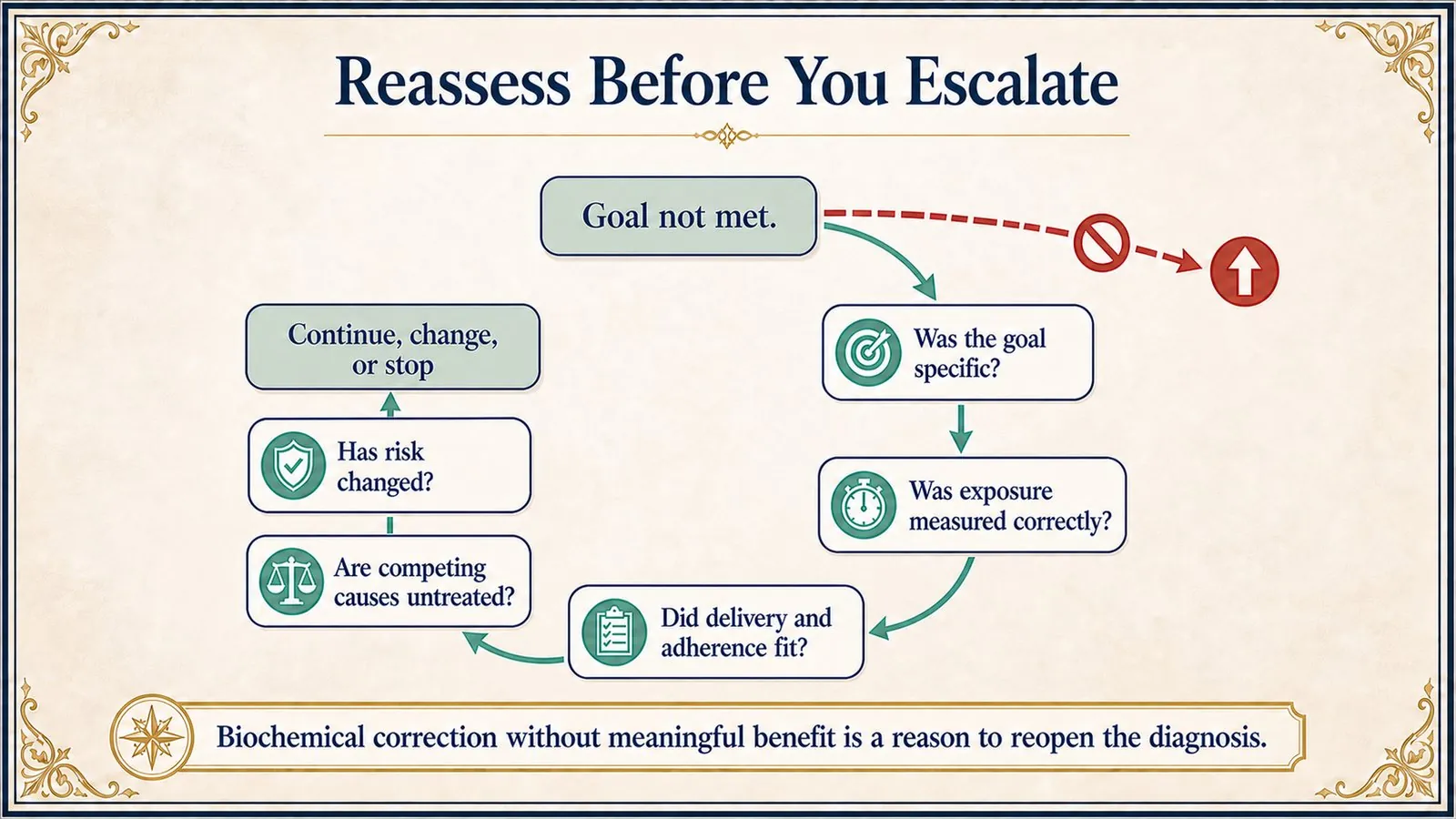
Removing testosterone removes one exposure, not every diagnosis. If hematocrit, blood pressure, or a prostate signal triggered the stop, each still requires follow-up. Lower desire, fatigue, hot flashes, or low mood can surface; severe depression, suicidal thinking, chest symptoms, or neurologic deficits need prompt care rather than patience with the axis. And restarting is a fresh decision: an old prescription does not establish a current indication.
Common questions
How long does it take for natural testosterone to come back after stopping TRT?
I cannot write a clock for an individual. The best controlled data tracked 303 men without pathological hypogonadism after two years of long-acting injectable undecanoate; their hormones came back slowly, trending toward baseline over about fifteen months, with some measures still recovering beyond twelve. That result does not transfer directly to a gel or a weekly injection, and recovery can be fast, slow, or incomplete.
Will my sperm count recover if I stop testosterone to have a child?
Recovery of sperm after stopping is common. I see it regularly, and the hormonal-contraception trials show many healthy men recovering over months, though those participants were selected and fertile beforehand. How long you were exposed, your age, prior fertility, baseline testicular function, and any anabolic compounds all shape the course. I will not promise a specific month, and early reproductive referral protects a couple's time better than waiting does.
Do I need a taper or post-cycle therapy to stop testosterone safely?
Published guidance contains no taper that prevents symptoms and guarantees recovery across formulations, and I do not have one to give you. A long-acting depot tapers on its own as it clears; a daily product falls on a different curve. "Post-cycle therapy" is anabolic-steroid culture without controlled evidence. Any individualized transition or off-label rescue medication is a decision for one man, made in the office with measurement attached.