
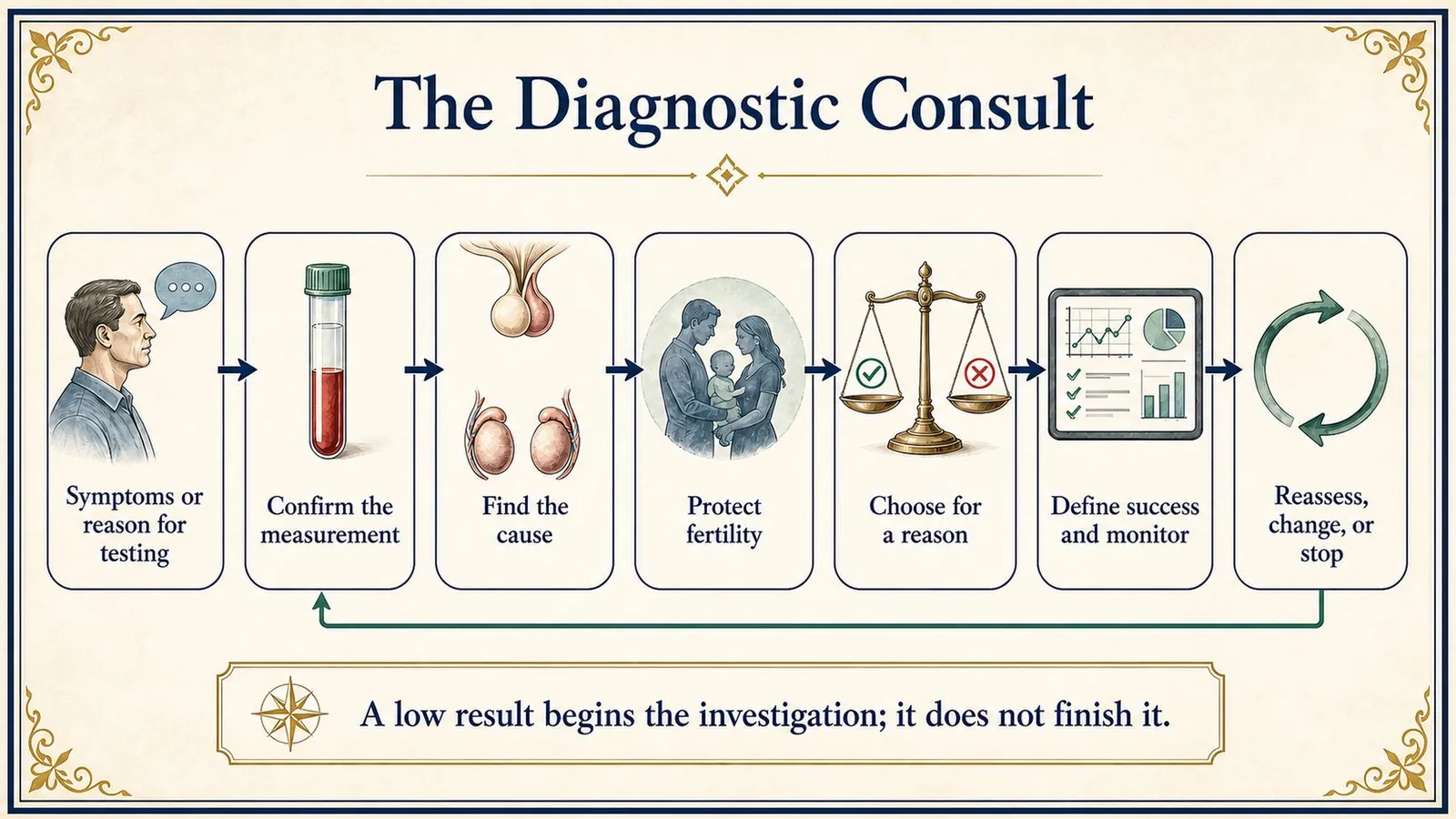
- Long-term treatment runs in a cycle, confirm, locate the cause, decide with current goals, define success, monitor, reassess, and Dr. Shusterman sees established patients about every six months with results on the table; he does not issue indefinite refills without a measurement.
- The original diagnostic story must be preserved or its gap documented; nine years of prescribing does not prove the diagnosis, and a medication list is not a diagnosis.
- Hematocrit (action threshold above 54 percent), blood pressure, and prostate and urinary follow-up stay continuous; PSA is followed at roughly six-month intervals in men over about fifty, read against baseline and confounders.
- Fertility is asked again at every stage of life, because prescription testosterone suppresses sperm production unpredictably and a blood level cannot report what the semen is doing.
- Care transitions and duplicate prescribing are safety events: one clinician owns the hormone plan, every result has an owner, and continuation is a positive decision, never doing nothing.
Every refill is a decision made again
A man in his ninth year of testosterone cannot explain why he began. Three clinicians renewed it, his insurer swapped the product, and at fifty-eight he has hypertension, new urinary symptoms, and a wife asking whether another child is possible.
Nine years of prescriptions do not prove a diagnosis to me, and I do not force an abrupt stop to reconstruct the past either. Long-term care runs as a loop: confirm what is known, find the cause, decide against today's goals, define success, monitor, and change direction when the balance shifts.
In my practice that loop has a cadence, and it is my choice rather than a guideline requirement. Established patients see me at roughly six-month intervals with symptoms and labs in hand, and I do not hand out open-ended refills without a measurement. A year is enough for hematocrit to rise, blood pressure to creep, and benefit to erode unnoticed. Stable patients need fewer adjustments, not fewer questions.
Keep the original diagnosis on the record
The long-term chart should carry the symptoms before treatment, each qualifying low testosterone value along with when it was drawn and on which assay, the LH and FSH pattern, the search for a cause, the fertility conversation, and why treatment was chosen. Otherwise the next clinician inherits a drug without its diagnosis. Missing records mean uncertainty, not blame; if I cannot verify the original diagnosis, I document the gap rather than invent one.
Where the axis failed still matters years on. A permanent testicular disorder makes continued replacement biologically expected, whereas obesity, a medication, or an illness can change over time.
Monitoring evolves with the man
Hematocrit stays central because erythrocytosis can emerge after years of unremarkable values. The published action threshold, hematocrit above 54 percent, is the boundary, and the trend and its cause deserve attention before it is reached.
Blood pressure needs the same continuity, since current class labeling warns that testosterone can raise it. A long history of steady PSA readings predicts nothing about the next one. For men on treatment past about fifty, I follow PSA at roughly six-month intervals; that is my practice, annual testing is defensible under the guidelines, and every PSA has to be read against baseline, age, prostate size, infection, and any drug that lowers it.
Medication lists lengthen with age. I treat that list as questions to ask out loud at each review, not a page to copy forward. And monitoring should stay proportional: ordering a panel without knowing how each result would change management mainly generates false alarms.
Fertility gets asked again
Reproductive intentions are not settled at the first visit. Divorce, a new marriage, a pregnancy loss, or a partner's age can make fertility matter years into treatment, and a note reading "family complete" should not close the subject permanently. I ask at every stage because prescription testosterone suppresses gonadotropins and sperm output to a variable degree that reverses unpredictably, and a serum testosterone reveals nothing about the semen. When a pregnancy becomes a goal, early semen analysis and a reproductive specialist protect the couple's time better than any assurance that stopping will restore fertility on schedule.
New illness reopens old decisions
A cardiovascular event, a clot, kidney injury, a cancer diagnosis, severe sleep apnea, or a major psychiatric change can tip the balance after years of benefit, and no consent given earlier answers that later question.
TRAVERSE's primary result reassures for selected men with confirmed hypogonadism and elevated cardiovascular risk using gel across a limited follow-up. It says nothing about lifetime risk or every route, and years without incident are not proof of future safety. The prostate evidence has the same edges. For selected men definitively treated for localized prostate cancer, I consider testosterone only if the cancer appears controlled, the PSA course has stayed low and steady, and the oncologist has been part of the discussion.
Testosterone can raise bone density in selected men, but the TRAVERSE fracture analysis recorded more clinical fractures on treatment, so replacement is not a strategy for preventing fractures.
Labels and evidence will keep moving
After new trial data, regulators withdrew the earlier boxed cardiovascular warning and added class-wide blood-pressure language. A man who consented under the old label deserves an updated explanation. A headline should open a conversation, never prompt an unsupervised change in dose or product or an unsupervised stop.
Handoffs are safety events
Relocation, an insurance change, entering Medicare, or losing a prescriber can splinter hormone care. A proper transfer packet contains the diagnostic evidence, formulation history, most recent exposure, measurement timing, goal and response, safety trends, fertility status, adverse effects, and any follow-up still pending. Where doubt persists, a supervised bridge usually beats automatic renewal or abrupt abandonment.
Duplicate prescribing is the specific danger once primary care, urology, endocrinology, and a commercial clinic all show up in the same chart. A single clinician should own the hormone plan, the others should know which product is current, and each result needs someone responsible for it.
Choosing to continue is an affirmative judgment that diagnosis, benefit, exposure, safety record, and burden all still fit this man. It is never the same as doing nothing. Years in, the question is whether he, with everything now known, should stay, change, pause, or stop, and a consult worth trusting keeps asking that for as long as he is exposed.
Common questions
How often should I see my doctor if I have been on TRT for years?
My established patients come in about every six months with symptoms and laboratory results to review, and I do not write open-ended refills without a measurement. That is my own cadence rather than a guideline requirement. Twelve months is enough time for hematocrit to rise, blood pressure to creep, and a benefit to erode without anyone noticing.
Does years of uneventful TRT use prove it is safe for me going forward?
It does not. The main TRAVERSE finding is reassuring for a selected group, men with confirmed hypogonadism at elevated cardiovascular risk, on gel, over limited follow-up; it does not answer lifetime risk or cover every route. A cardiovascular event, a clot, a cancer diagnosis, severe apnea, or a psychiatric change can shift the balance after years of benefit, and no earlier consent settles that later question.
I told my doctor years ago my family was complete. Does fertility still matter on TRT?
It does. Divorce, remarriage, a pregnancy loss, a partner's age, or shifting values can make fertility matter again years into treatment, which is why I keep asking. Prescription testosterone suppresses sperm output to a variable degree, reverses unpredictably, and leaves the blood level unable to say anything about the semen. When a pregnancy goal appears, early semen analysis and a reproductive specialist protect your time.