
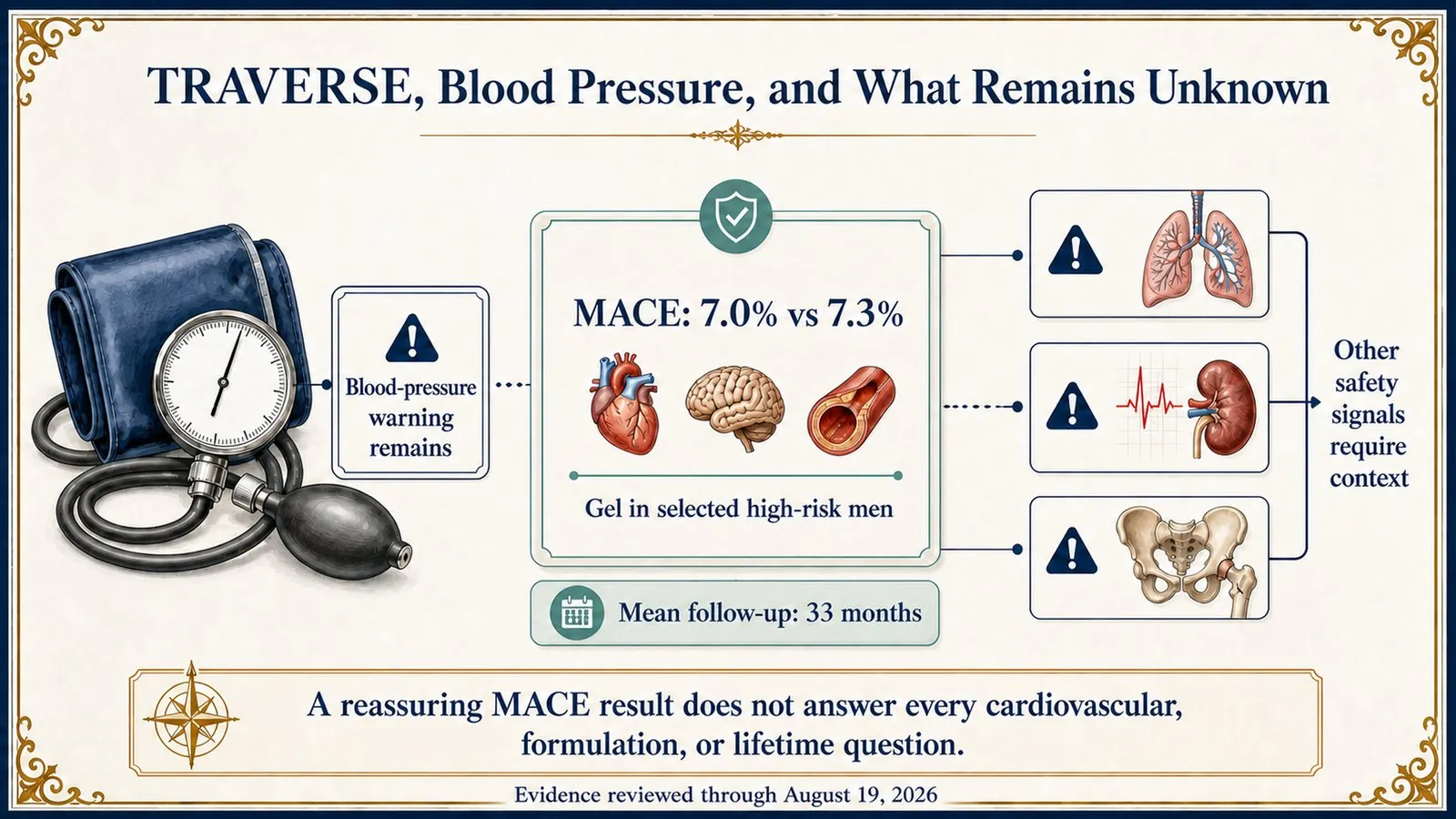
- TRAVERSE showed monitored testosterone gel was not unacceptably worse than placebo for cardiovascular death, heart attack, or stroke over about three years in men with confirmed low testosterone and cardiovascular risk.
- That is reassurance, not "heart-safe": it does not cover lifetime use, every formulation, or men without confirmed hypogonadism.
- Since 2025 all testosterone products carry a warning that they can raise blood pressure; the measured shifts differ by product.
- Pulmonary embolism, atrial fibrillation, acute kidney injury, and clinical fractures occurred more often in the testosterone group and stay on the table.
- A better testosterone number replaces none of the treatments proven to reduce cardiovascular risk.
The question the trial was built to answer
One patient shows me an ad claiming a landmark trial proved testosterone heart-safe; the next shows me a friend's text claiming the same trial exposed dangerous clots and broken bones. Neither is lying, and neither describes what the study measured. TRAVERSE addressed something narrower than either headline: one selected population, one route of delivery, one limited stretch of time, one primary outcome.
The trial enrolled 5,246 men between forty-five and eighty with hypogonadal symptoms and two fasting testosterone readings under 300 nanograms per deciliter, every one of them with existing cardiovascular disease or an elevated risk profile, randomized to testosterone gel or placebo gel.
The primary outcome bundled cardiovascular death, nonfatal heart attack, and nonfatal stroke. It happened to 182 men in the testosterone arm (7.0 percent) and 190 in the placebo arm (7.3 percent), for a hazard ratio of 0.96 with a 95 percent confidence interval of 0.78 to 1.17, which fell inside the noninferiority margin fixed before the trial began. Noninferiority has a precise meaning: within that design and margin, testosterone gel was not shown to cause an unacceptably higher rate of the composite than placebo. It does not mean cardiovascular events were ruled out or that treatment prevented any heart attacks or strokes.
Average exposure was roughly twenty-two months and follow-up about thirty-three, a brief window next to the decades of therapy that can follow a midlife diagnosis. Participants used a monitored gel; the finding should not be assumed to hold for every injection, oral product, pellet, or compounded preparation.
How I explain it in the exam room
I compress the trial into one sentence with its limits attached: for symptomatic men with two low fasting levels and cardiovascular risk, roughly three years of monitored gel did not produce an unacceptably higher rate of cardiovascular death, heart attack, or stroke than placebo. That is real reassurance, and I say so. Then I list what it leaves open: lifetime exposure, other formulations, men never properly diagnosed, and outcomes outside the composite.
One phrase I refuse to use is heart-safe. The event rates do not show the heart was protected, and advertising that converts "not unacceptably worse" into "good for your heart" has abandoned the evidence. The FDA's 2025 decisions, dropping the older boxed-warning wording while adding a blood-pressure warning, were two distinct regulatory actions, not a declaration of cardiovascular neutrality.
Blood pressure: a class warning built on product-level data
In 2025 the FDA required every prescription testosterone product to carry a warning that it can raise blood pressure, based on ambulatory monitoring studies that record pressure throughout the day and night. The warning covers the class, but the numbers behind it came from individual product studies and vary between them. A few millimeters of mercury sounds negligible, yet a drug-related increase weighs more in a man who already has hypertension, kidney disease, or several vascular risks.
In a single-arm study of oral Kyzatrex, mean systolic pressure was up roughly 1.7 millimeters of mercury by day 120 and 1.8 by day 180, with larger increases among men already taking antihypertensives. A separate single-arm study of oral TLANDO followed 138 men for about four months; mean twenty-four-hour pressure rose 3.8 systolic and 1.2 diastolic, and hematocrit climbed an average of 3.2 percentage points. The Testim gel label describes a sixteen-week substudy in which 113 of 225 participants had usable recordings and mean systolic pressure rose 2.7 with diastolic up 1.1. Each figure belongs to one product in one study; none predicts what another route will do.
No patient should adjust his antihypertensives or his testosterone over a single reading; a persistent rise under reliable conditions deserves prompt clinical review.
The secondary findings still matter
Most secondary outcomes in TRAVERSE looked similar between arms, but pulmonary embolism, atrial fibrillation, and acute kidney injury were more frequent with testosterone. Secondary results lack the authority of the primary endpoint, and a trial making many comparisons will turn up some differences by chance. They remain clinically meaningful, and I keep them in view. New breathlessness, chest pain, fainting, one-sided leg swelling, palpitations, or an irregular pulse is never brushed off because the composite was reassuring.
Fractures were analyzed as a prespecified outcome in 5,204 participants, median follow-up 3.19 years. On testosterone, 91 of 2,601 men (3.50 percent) had a clinical fracture; on placebo, 64 of 2,603 (2.46 percent). The hazard ratio was 1.43, confidence interval 1.04 to 1.97. Put in absolute terms, roughly one additional fracture per hundred men over the observed period; put in relative terms, a meaningfully higher hazard. A patient deserves both framings. Testosterone is not a proven fracture-prevention therapy and should not be sold as one.
Heart care continues after the prescription is written
Risk control starts with confirming that a man actually has hypogonadism, then an approved product suited to him, a recorded cardiovascular baseline, attention to uncontrolled risk factors, and a surveillance plan. Blood-pressure management, smoking cessation, lipid and diabetes treatment, sleep-apnea therapy, and indicated cardiac medications each rest on their own evidence, and a better testosterone level replaces none of them. Sudden chest pain, severe breathlessness, fainting, or anything suggesting a clot means emergency evaluation, not waiting for the next hormone panel.
After TRAVERSE the honest message is neither "testosterone is dangerous" nor "testosterone is safe." A patient is better served by precision than by either slogan.
Common questions
Did the TRAVERSE trial prove testosterone is safe for the heart?
No. What it showed is that, for symptomatic men with two low fasting levels and existing or elevated cardiovascular risk, roughly three years of monitored testosterone gel did not produce an unacceptably higher rate of cardiovascular death, heart attack, or stroke than placebo. That is real reassurance, but it is not evidence that the heart was protected, and I do not use the phrase heart-safe.
Does TRT raise blood pressure?
Every prescription testosterone product now carries a class-wide FDA warning that it can raise blood pressure, drawn from ambulatory monitoring studies. The increases measured were a few millimeters of mercury and varied by product, with bigger rises in some men already taking antihypertensives. A small shift carries more weight if you start with hypertension or kidney disease, so I follow blood pressure as a trend from your baseline.
Does testosterone therapy cause blood clots or fractures?
In TRAVERSE, pulmonary embolism, atrial fibrillation, and acute kidney injury were more frequent in the testosterone arm, and clinical fractures were more common as well (3.50 versus 2.46 percent). Those signals do not prove that every treated man faces a predictable excess, but they mean a history of clotting, new breathlessness or one-sided leg swelling, and fall and bone health each deserve their own attention.