
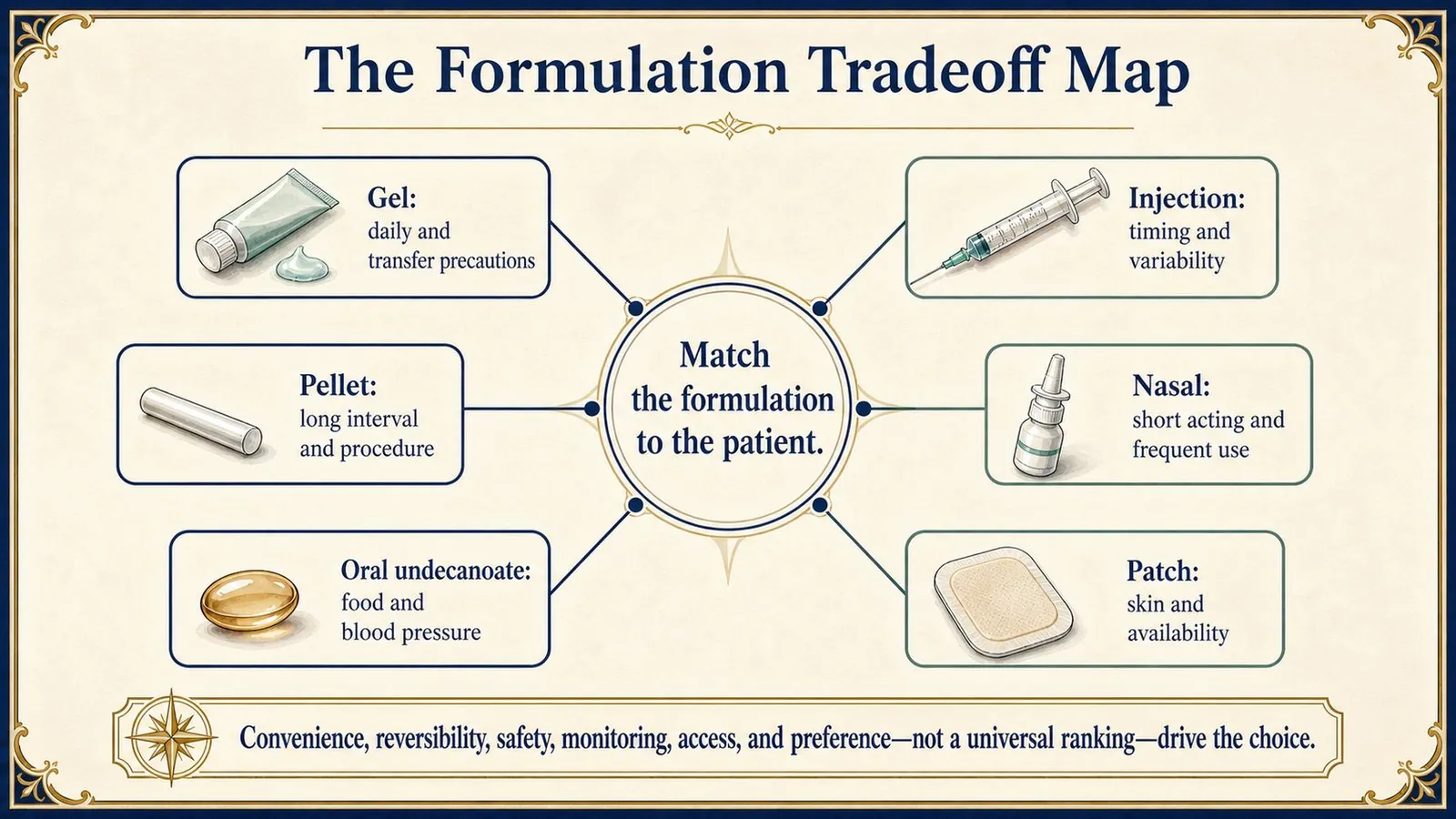
- The hormone is the same across products; delivery changes exposure pattern, reversibility, transfer risk, monitoring, and burden.
- Gels carry a boxed warning about transfer to women and children; Xyosted and the oral undecanoate products (Jatenzo, Tlando, Kyzatrex) carry boxed warnings about blood pressure.
- Dr. Shusterman favors subcutaneous pellets for men with proven benefit and stable monitoring, but rarely starts a first trial on pellets because they cannot be dialed back.
- No formulation is fertility safe; all exogenous testosterone can suppress gonadotropins and sperm production.
- Choose by eliminating unacceptable features, then by the patient's leading priority; a switch needs a reason and the original goal stays the anchor.
Rankings Are the Wrong Frame
A man arrives with a podcast ranking: injections best, pellets next, gels last. That list confuses how a product feels to use with what the drug does. Every product delivers the same molecule; delivery changes the exposure curve, ease of correct use, transfer risk, procedures, reversibility, blood-draw timing, blood-pressure labeling, hematocrit response, cost, and daily burden. So I do not ask which route wins. I ask which tradeoffs a man can live with, safely and consistently, for as long as the treatment keeps earning its place. And the question only arises once candidacy is settled; delivery cannot fix an unconfirmed diagnosis.
What Actually Separates the Routes
- How often, and how reversible. Less frequent dosing is easier on the calendar, but a side effect takes longer to walk back. A daily gel stops almost immediately; a pellet keeps releasing whether you want it to or not. That matters most in a first trial.
- Whether the product is used as intended. Skipped gel applications, a mistimed blood test, an oral dose taken without the required meal, or forgotten nasal doses all generate confusing labs. Before I blame a formulation, I ask how it is really being used.
- Who else is in the house, and how much monitoring. Topical gels carry a boxed warning about secondary exposure, so transfer precautions are mandatory. Lab work differs by route; no route skips it.
The Options One by One
Gels
A gel gives daily dosing with no needle and no procedure, and a clinician-directed change shows up fairly quickly. Absorption varies, so the level is measured, not assumed. Because TRAVERSE used gel, its cardiovascular noninferiority result speaks most directly to protocol-guided gel in that selected population. That reassurance does not cancel the class blood-pressure warning, the hematocrit checks, or the fertility suppression.
Injections
Injectable products vary in formulation, route, interval, device, and exposure curve. Many men prefer them to daily skin application; others cannot tolerate needles or self-injection. When the interval is short, levels rise and fall between doses, so the monitoring plan has to specify the timing of the blood draw. Some observational cohorts report more erythrocytosis with injections than with gels or pellets, but nobody was randomized, so the lesson is route-specific vigilance rather than a fixed percentage. Xyosted, the weekly subcutaneous testosterone enanthate autoinjector, carries a boxed warning about blood-pressure increases.
Pellets
Pellets go under the skin in an office procedure and release testosterone for an extended period. Once in, the dose cannot be fine-tuned or easily halted, and insertion can cause bleeding, bruising, pain, infection, scarring, or extrusion.
Nasal
The nasal product has a short exposure profile, no transfer risk, and no needles, in exchange for several doses a day. Small studies suggested gonadotropins and semen parameters held up more often than with longer-acting products, but they were brief, lost many participants, and never measured pregnancy. The label still warns that exogenous androgens can suppress sperm production; calling it "fertility safe" is not honest.
Oral testosterone undecanoate
The approved oral products spare a man needles, transfer, and procedures, but each has its own food instructions because absorption depends on them. They are not risk-free: Jatenzo, Tlando, and Kyzatrex each carry a boxed blood-pressure warning, and oral dosing still suppresses the reproductive axis.
Patches and compounded preparations
A patch sidesteps the wet-gel transfer problem but is limited by skin irritation, adhesion, and availability. Compounding fills a real gap when no approved product will work, but a compounded product is not presumed equal in potency, delivery, quality control, or evidence, and "bioidentical" proves nothing about superiority.
My Own Default, With Its Price Tag
Patients want to know what I use most, and dodging the question would be its own evasion. For many men who have already demonstrated that testosterone helps and whose labs are stable, my preference is subcutaneous pellets. One office implantation covers roughly four months with no weekly needle and no daily application, a genuine advantage for a man who travels or forgets doses. The cost is equally plain: exposure cannot be turned down, and the procedure carries small risks. That is precisely why I almost never begin with pellets. I want proof the treatment works, and his hematocrit, blood pressure, and prostate picture steady, before committing to a route I cannot quickly reverse.
When pellets do not suit a man, my next convenience option is Xyosted, the weekly subcutaneous autoinjector, boxed blood-pressure warning in full view. None of this makes another route wrong; a perfect regimen a man cannot stick to is worth nothing.
How to Choose, and When to Switch
The practical conversation begins with subtraction: a household that cannot keep up transfer precautions eliminates gels, severe needle aversion eliminates self-injection, a need for quick reversal eliminates pellets, chronic nasal disease eliminates the nasal product. Whatever survives is weighed against the man's top priority. Fertility is not a dimension that rescues any standard formulation; every exogenous testosterone product can suppress gonadotropins and sperm.
A switch needs a reason. I record the last dose of the old product, the start of the new one, and the date of the follow-up measurement. If a more convenient route lifts the number but leaves the target symptom untouched, nothing has been solved. And when several formulations have produced appropriate exposure without meaningful benefit, the diagnosis and the goal deserve the second look, not the delivery system.
Common questions
Which form of testosterone is best: gel, injection, or pellet?
None of them wins outright. The molecule is identical; what changes is the exposure curve, how quickly it can be reversed, transfer risk, whether a procedure is needed, monitoring, cost, and daily burden. A route is only better relative to your goal and your life. Start by crossing off what you cannot accept, such as needles or a household that cannot follow gel precautions, then weigh what is left against your top priority.
Why doesn't Dr. Shusterman start patients on pellets?
Pellets are my preferred route for many men who have already shown that testosterone helps and whose hematocrit, blood pressure, and prostate picture are steady, because a single implantation lasts roughly four months. The drawback is that exposure cannot be dialed down or stopped quickly once they are in, and the insertion carries small risks. For a first trial I want a route that can be reversed if it does not work.
Is nasal testosterone safe for fertility?
No testosterone product deserves the label fertility safe. The nasal product has a short exposure profile, and small studies found gonadotropins and semen parameters held up more often than with longer-acting forms. But those studies were brief, lost many participants, and never measured pregnancy, and the approved label still warns that exogenous androgens can suppress sperm production. A man who wants children needs a reproductive plan, not a delivery route.