
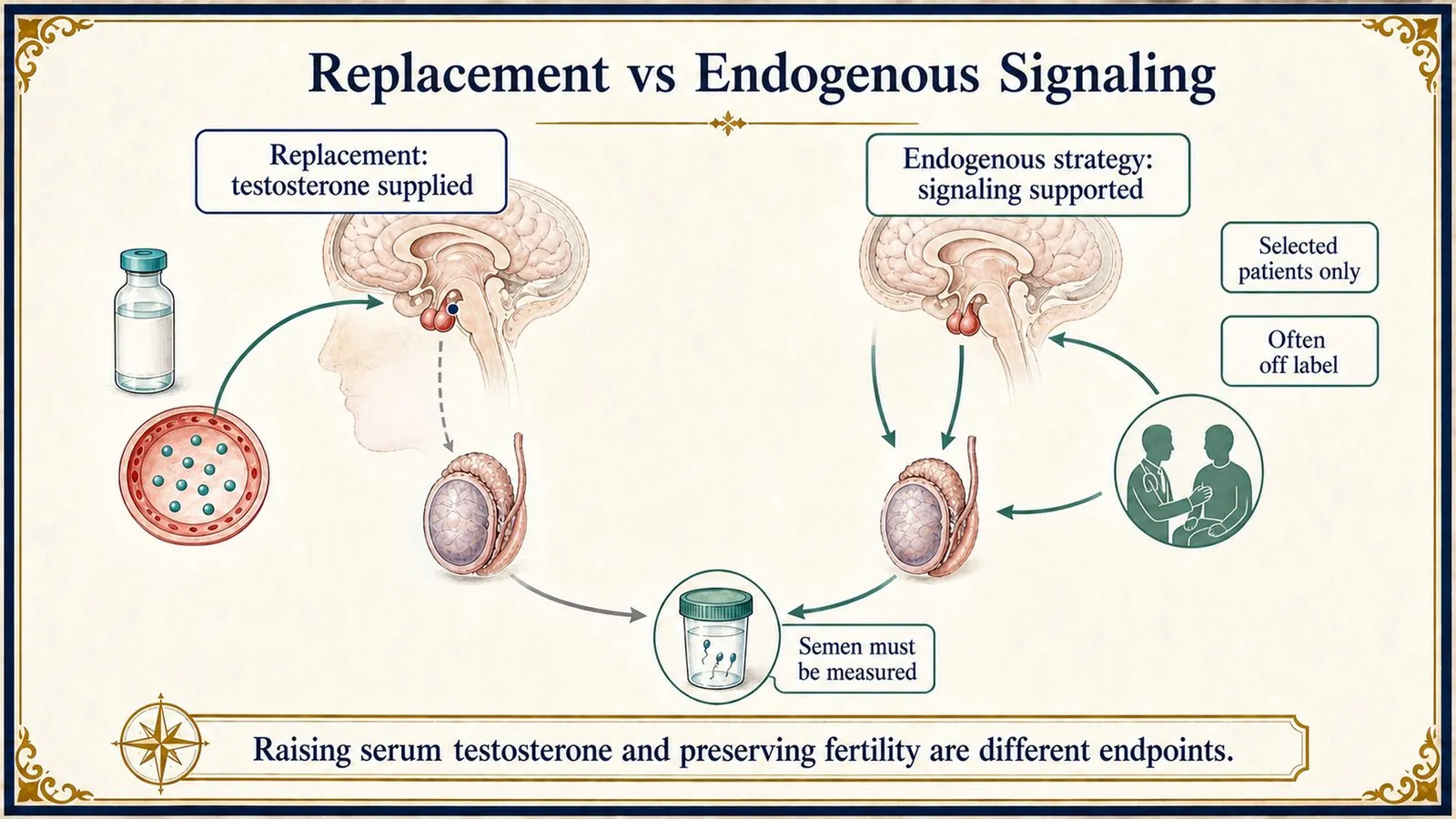
- Exogenous testosterone raises blood levels while suppressing LH, FSH, intratesticular testosterone, and sperm; stimulating approaches only work when the pituitary and testes can still respond.
- Clomiphene and hCG-alongside-TRT are off label in men; enclomiphene has no FDA-approved product and is unapproved, not off label.
- Dr. Shusterman uses clomiphene, or preferably enclomiphene, before testosterone in selected secondary-pattern men who want fertility, with hCG as the alternative.
- No add-on has been shown to reliably protect fertility during TRT; guidance says the data are too limited for a general solution.
- Semen must be measured before and during any fertility-conscious plan; a rising testosterone number proves nothing about sperm.
Two Different Strategies
Men who want both normal testosterone and normal sperm tend to arrive with a shopping list: clomiphene, hCG, nasal testosterone, and various combinations, each promised to "raise T without hurting fertility." Nothing on that list guarantees both.
The distinction that matters is replacement versus stimulation. Prescription testosterone pushes blood levels up and, at the same time, turns down LH, FSH, the testosterone made inside the testes, and sperm output. A stimulating strategy instead asks the pituitary and testes to do more, which only works if those organs can still respond. A fertility-conscious plan is not TRT under another name, and any such plan has to measure the thing it claims to preserve.
Know the Pattern Before Picking the Drug
With primary hypogonadism, the testes underperform even though the pituitary is signaling loudly, and amplifying that signal will not repair badly damaged testes. With secondary hypogonadism, LH and FSH are low or inappropriately normal, and some of these men have testes that will respond once the signal is restored or imitated. But "secondary" covers many causes, each needing its own treatment. Baseline fertility is equally important: neither prior children nor a normal serum testosterone substitutes for a current semen analysis, and the partner's reproductive timeline determines how much uncertainty a couple can afford.
hCG and the SERMs
hCG acts on the same testicular receptor LH uses, supporting intratesticular testosterone production. Its FDA approval covers selected cases of male hypogonadotropic hypogonadism; pairing it with TRT to keep sperm production going is generally off label. In one retrospective series of twenty-six men taking testosterone plus low-dose hCG, no one became azoospermic, semen parameters held steady, and nine partners conceived. The series was small, hand-picked, and had no control group.
SERMs blunt estrogen feedback so LH and FSH rise, assuming the axis can answer. Clomiphene citrate is approved for ovulatory dysfunction in women, not for hypogonadism or infertility in men, so male use is off label. Trials commonly report higher testosterone and better symptom scores, but neither demonstrates preserved sperm. A randomized study of 282 men hoping to keep their fertility compared clomiphene, hCG, and the two together over three months; testosterone and symptoms improved, and semen, pregnancy, and live-birth results were not reported.
Enclomiphene is one of clomiphene's two components. No FDA-approved enclomiphene product exists, which makes it unapproved rather than off label. Two phase III trials in 256 overweight men with secondary hypogonadism and adequate baseline sperm counts showed that over sixteen weeks enclomiphene raised testosterone while keeping gonadotropins and sperm counts up better than testosterone gel did. Follow-up was brief, pregnancy was never assessed, and FDA reviewers subsequently found the program could not adequately demonstrate clinical benefit.
My Practice: SERM First, hCG Second, Nothing Assumed
For selected men with a secondary pattern, a pituitary and testes that can still respond, and fertility that matters now or soon, I start with clomiphene, or preferably enclomiphene, rather than testosterone. That is my clinical preference, not a guideline mandate. Male-infertility guidance lists these agents among the options and leaves the choice to the treating clinician, and no guideline can endorse enclomiphene when there is no approved product to endorse. I lean toward the SERM because it puts a man's own axis to work instead of shutting it down, so the testes keep getting the LH and FSH that sperm production requires. When a SERM is not possible or not wanted, hCG is my second choice.
Occasionally, in a symptomatic fertility-conscious man, I have added exogenous testosterone when a SERM raised the number without changing how he felt. I do not represent that combination as a proven way to protect fertility; exogenous testosterone can still suppress gonadotropins and sperm, and current male-infertility guidance considers the data too thin to support any add-on as a general fertility-preservation answer. The one thing I refuse to do is assume. I measure semen before and during every one of these plans, and no climbing testosterone value earns anyone the word "protected."
Short-acting nasal testosterone remains exogenous testosterone. A prospective study enrolled sixty men, with thirty-three still being followed at six months; 93.9 percent of those kept a total motile sperm count above five million, but there was no comparison arm and pregnancy was not measured. I present it as a replacement product that, in some men, seems to suppress the axis less, with the label's sperm warning intact.
Measure What You Claim to Protect
Serum testosterone reflects exposure, LH and FSH reflect pituitary signaling, and symptoms reflect how a man feels. None of them tells you whether sperm production is adequate. Whenever preserving or recovering fertility is the goal, a semen analysis sits at the center of the plan, often repeated. The endpoint has to match the intention: keeping sperm above a research cutoff, returning to a personal baseline, banking a sample, and achieving pregnancy are different targets, and I say which one we are pursuing.
For a man actively trying to conceive, exogenous testosterone is generally incompatible with that immediate goal. His original symptoms still get treated, a male-fertility specialist joins when the timeline is complicated, and the partner's workup runs alongside. Consent for off-label use should spell out what is approved, what is not, and which finding would end the trial. "Fertility-conscious" names a goal; it does not lower the standard of supervision.
Common questions
Can I take hCG with TRT to protect my fertility?
hCG's FDA approval covers selected cases of male hypogonadotropic hypogonadism; adding it to testosterone to keep sperm production going is generally off label. The small studies are encouraging, among them a series of twenty-six men with no azoospermia and nine partner pregnancies, but they were small, selected, and uncontrolled. Male-infertility guidance considers the data too limited to back this as a general fertility-preservation strategy, so semen has to be measured directly.
Is clomiphene or enclomiphene a good alternative to testosterone?
For selected men with a secondary pattern, a pituitary and testes that can still respond, and fertility that matters now or soon, I start with clomiphene, or preferably enclomiphene, before testosterone. Clomiphene is off label in men; enclomiphene has no FDA-approved product at all. Trials in selected men show higher testosterone and better symptom scores, but a higher testosterone does not prove sperm were preserved, and symptoms do not always improve.
Can I stay on testosterone while trying to conceive?
If you are actively trying to conceive, exogenous testosterone is generally incompatible with that immediate goal because it can shut down sperm production. Step one is to stop treating your serum testosterone as the reproductive endpoint. Your original symptoms still get care, a male-fertility specialist joins when the timeline is complicated, and your partner's evaluation runs in parallel. Banking sperm is worthwhile when sperm are present.