
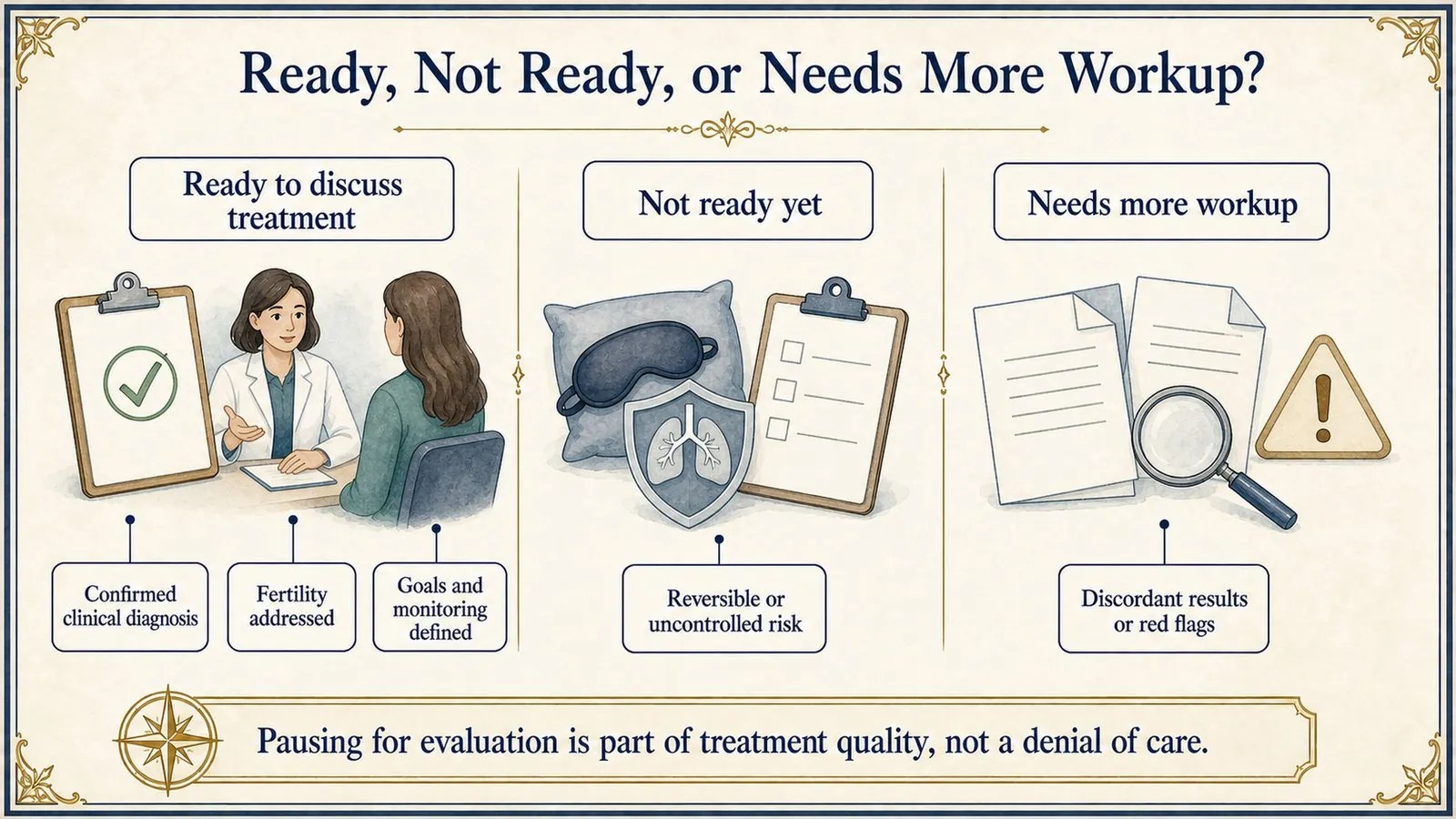
- Every consult ends in one of three lanes: ready to consider treatment, not ready, or needs more workup, and new information moves a man between them.
- High hematocrit, uncontrolled blood pressure, untreated severe sleep apnea, unstable heart failure, concerning prostate findings, and a heart attack or stroke within six months pause a start rather than permanently exclude.
- Men who want current or future fertility should not start exogenous testosterone without another reproductive plan.
- Ready does not mean obligated; declining or deferring TRT with structured observation is a medical option in its own right.
- Shared decision-making has boundaries: route is a preference, but bypassing a safety concern is not.
Three Categories Instead of a Debate
Whether a man qualifies for testosterone is usually treated as a contest between believers and doubters. That is not how I work. Every man who sits across from me lands in one of three categories, and I tell him which before he leaves. He is either ready to weigh treatment; not ready, because a safety issue or a competing goal collides with treatment at this moment; or in need of more evaluation, because the diagnosis or its cause is still unsettled.
These are not points on a scale. They exist to organize the questions that make a decision defensible. Has deficiency been proven? Has the cause been looked into? Do his fertility plans fit what is proposed? Does something else need treating first? What benefit would make the burden worthwhile? This framework is mine, not a guideline algorithm. "Not yet" is a genuine answer in my office, and so is "no treatment." I do not prescribe to settle an argument, and I do not retreat into uncertainty to send away a man whose deficiency is documented and persistent.
What Candidacy Rests On
The major endocrine and urologic guidelines begin with symptoms or signs consistent with androgen deficiency, backed by testosterone that stays low when measured under the right conditions. Repeating the test guards against acute illness, poor sleep, and mistimed draws, and the LH and FSH pattern indicates whether the problem is testicular or central. A man with a durable biological cause and symptoms to match may have a straightforward case for replacement. A man whose level dropped while hospitalized or badly sleep-deprived is usually better served by recovering and testing again. The symptom being targeted also has to be spelled out, because "I want to feel better" is too vague to tell anyone whether treatment worked.
What Puts a Start on Hold
Certain findings should delay initiation until the cause or the risk has been dealt with: elevated hematocrit, blood pressure that is not controlled, severe apnea nobody has treated, unstable heart failure, worrying prostate findings, or severe urinary symptoms. What follows is evaluation and stabilization, not an automatic lifetime exclusion.
- A recent heart attack or stroke. Endocrine guidance advises against beginning testosterone within six months of either, and urologic guidance likewise calls for a waiting period. Neither is permanent. New chest pressure, stroke symptoms, fainting, or severe breathlessness is not a candidacy question at all; it needs urgent evaluation.
- Elevated hematocrit. Before adding a drug that can push red-cell mass higher, I need to know why it is already high. During treatment, the major urology and endocrine guidelines mark a hematocrit over 54 percent as the level at which something has to change.
- Severe sleep apnea that is untreated. A guideline-based reason to wait, though not a bar to every man who snores.
- Blood pressure. Current testosterone labeling warns that these products can raise it. A single mildly elevated office reading calls for confirmation, not cancellation. Severe or uncontrolled hypertension alters the safety conversation.
Circumstances That Reshape the Decision
A man who wants children now or later should generally not begin exogenous testosterone without a separate reproductive plan, since treatment can suppress LH, FSH, testosterone within the testes, and sperm production. Prostate cancer that is known or suspected, breast cancer in a man, a worrying prostate exam, or a PSA result nobody has evaluated needs assessment specific to that disease. The Endocrine Society lists thrombophilia among its reasons not to start. TRAVERSE found no excess in its primary major cardiovascular endpoint, but pulmonary embolism was more frequent on testosterone, which is a reason not to wave off a history of clots. Uncontrolled heart failure is grounds for deferral.
I keep these categories distinct. A contraindication is printed in the product's prescribing information and carries regulatory force. A guideline caution advises against starting in a specified situation. An unfinished workup means I simply do not know enough yet. Age by itself never determines the category.
Ready Is Not the Same as Obligated
Being ready means the diagnosis holds up, causes and alternatives have been weighed, fertility goals fit, and no open safety issue outweighs a monitored trial. Choosing a formulation comes after candidacy; a convenient injection or a subscription service cannot make an unconfirmed diagnosis appropriate. Monitoring is built into the prescription.
Expectations have to track the evidence. In selected symptomatic men, desire may improve; body composition sometimes shifts; and certain older men with confirmed low testosterone have seen anemia improve. What I will not promise as a bundle is vitality, mood, cognition, erections, weight loss, and athletic performance. A trial with a time limit is reasonable, provided it comes with a rule for stopping.
Turning down or postponing TRT is not neglect. Observation has its own structure: symptoms are recorded, competing explanations are treated, and testosterone is rechecked when circumstances shift. No physiologic window closes because a man takes time to confirm a diagnosis or get a second opinion. Shared decision-making has limits as well. Gel versus injection is a preference once candidacy is settled, but starting during an active attempt to conceive or skipping past a suspicious prostate finding is not a matter of taste. Nor is the first decision a permanent clearance. A new fertility goal, a cardiovascular event, a climbing hematocrit, or a loss of benefit puts the question back on the table.
Common questions
Can I start TRT if I recently had a heart attack or stroke?
Endocrine guidance advises against beginning testosterone within six months of a heart attack or stroke, and urologic guidance likewise calls for a waiting period grounded mostly in expert judgment. Neither is a lifetime exclusion, but a recent event matters for timing. Any new chest pressure, stroke symptoms, fainting, or severe breathlessness needs urgent evaluation first; the testosterone question can wait.
Does high blood pressure mean I cannot take testosterone?
Not by itself. Current testosterone labeling warns that these products can raise blood pressure, so pressure is part of the baseline. A single mildly elevated office reading calls for confirmation, not cancellation. Severe or uncontrolled hypertension alters the safety conversation and keeps a man in the not-ready category until it is under control, with monitoring arranged before treatment starts rather than after a rise turns up.
Is choosing not to treat low testosterone a mistake?
No. Turning down or postponing TRT is a legitimate medical choice when treatment is not urgently needed. Some men would rather work on sleep, weight, medications, or mood first, or their symptoms are mild. Observation still has structure: symptoms are recorded, competing conditions are treated, and testosterone is rechecked when circumstances shift. No physiologic window closes because you take time to confirm the diagnosis.