
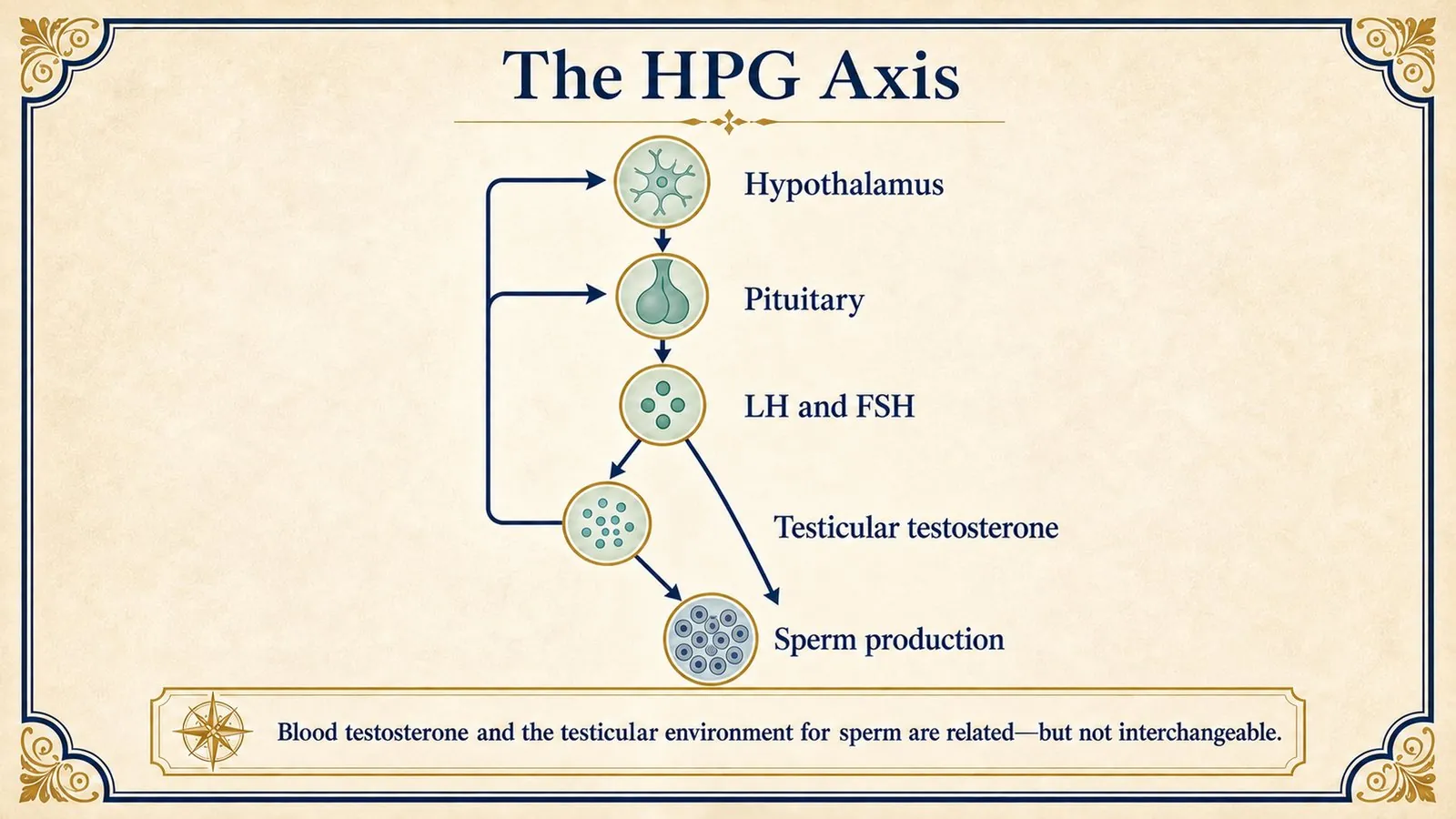
- Testosterone production runs on a feedback loop; prescription testosterone raises blood levels while switching off LH, FSH, and the testes' own signaling.
- Blood testosterone and the testicular environment that makes sperm are related but not interchangeable; a normal serum level on TRT says nothing about sperm.
- Replacement, restoration, and enhancement are three different goals with different evidence and risk.
- Estradiol and DHT are normal products of testosterone with real jobs, not waste to be corrected.
- Exogenous testosterone often makes replacement long term, so nobody should start without hearing that.
One Signal Among Many
Almost every week a man tells me some version of "sort out this one hormone and the rest will follow." There is a kernel of truth there: testosterone has a hand in strength, sex drive, energy, and fertility. The mistake is confusing having a hand in something with running it. A louder signal does nothing for a receiver that was never broken.
Where Testosterone Comes From
Production runs through a chain of command from hypothalamus to pituitary to testes. The hypothalamus sends out GnRH in pulses; those pulses tell the pituitary to secrete LH and FSH. LH mostly drives the Leydig cells, which manufacture testosterone. FSH mostly drives the Sertoli cells, which support developing sperm, and sperm production also depends on testosterone concentrations inside the testes that are far higher than anything in the bloodstream. LH, FSH, blood testosterone, intratesticular testosterone, and sperm count are connected but distinct measurements.
Negative feedback governs the chain: the brain reads the testosterone level and adjusts its output. That is why a prescription raises the blood value while switching off the signals that drive the testes, and why the surrounding hormones make such a useful map. When testosterone is low and LH is high, the pituitary is shouting and the testes are not responding. When testosterone is low and LH is low or inappropriately normal, the problem sits upstream, in the brain's signaling. A formulation can replace testosterone in either scenario without making the causes interchangeable. Chemotherapy damage, opioid suppression, severe obesity, and a pituitary tumor each call for a different conversation even when the first lab value is identical.
From Circulating Hormone to Tissue Effect
Inside a tissue, testosterone takes one of three paths: cells use it directly, convert it to dihydrotestosterone via 5-alpha-reductase, or convert it to estradiol via aromatase. In men, estradiol does substantial work for bone and contributes to aspects of sexual and metabolic function. Labeling it a "female hormone" or treating every metabolite as waste misrepresents ordinary male physiology.
Replacement should not be marketed as puberty on demand. A results page listing testosterone, dihydrotestosterone, estradiol, SHBG, and a stack of calculated indices invites the impression that every deviation demands a fix. Extra measurements earn their place by answering a question.
Mechanism Before Medication
The principle I lean on above all others, and it is my own, is mechanism before medication. Before writing anything, I want to name the failed function, locate the failure within the system, and explain why the drug I am proposing repairs that function rather than nudging a number. I organize the discussion around three words patients tend to run together:
- Replacement corrects a documented deficiency in pursuit of outcomes we have named, while I watch for harm.
- Restoration lifts a suppressor off an axis that still works, whether that means recovering from illness, changing a medication, treating sleep apnea, or improving metabolic health.
- Enhancement pursues levels or performance beyond what treating disease calls for, and it carries a different evidence base and a different risk profile.
One more thing gets said before anyone starts. Outside testosterone, particularly at higher exposures, tends to shut down the man's own production, after which maintaining his level usually means staying on replacement indefinitely. Recovery after stopping is variable, hence "usually" rather than "always." But no one should begin without hearing it, because a therapy that may become lifelong is not a casual trial.
Sex, Sperm, Muscle, Bone, and Blood
Testosterone feeds desire, spontaneous sexual thoughts, and elements of arousal, but it does not produce an erection by itself. That requires working nerves, blood flow, relaxed smooth muscle, sufficient stimulation, and a mind willing to be aroused.
Reproduction draws on testosterone in a different way. Making sperm requires local testosterone inside the testes at concentrations far above the blood level. A small controlled study gave twenty-nine healthy men exogenous testosterone for three weeks; in the suppressed placebo arm, gonadotropins collapsed and intratesticular testosterone fell by roughly 94 percent even as blood levels were held up from outside. It never measured sperm counts or pregnancies, so it supports no guarantees either way. Its value is mechanistic: replacing testosterone in the blood silences the signals that maintain the environment sperm production depends on. That is why exogenous testosterone is not dependable contraception, and why a man hoping for children should take no comfort from a normal serum value while on a suppressive drug.
Testosterone also maintains lean mass, participates in bone remodeling both directly and through estradiol, and stimulates red-cell production. Each has a flip side: the biology that corrects anemia in selected men can drive hematocrit too high, which is why blood counts are part of monitoring. Body fat and testosterone push on each other in both directions; when obesity is the likely contributor and no other organic cause is found, current endocrine guidance puts weight-centered care first, and I agree, while still treating a confirmed symptomatic deficiency.
Questions the Hormone Cannot Answer
Testosterone cannot tell you whether a relationship is loving or sexually workable, diagnose why a man is tired, or distinguish vascular erectile dysfunction from low desire. It does not measure masculinity or worth, and being low does not by itself make treatment the right move. So every treatment trial starts with a prediction: which function should improve, on what timeline, measured by what, and what result would show the causal story was mistaken.
Common questions
Does TRT shut down your own testosterone production?
Yes. Because the axis runs on negative feedback, prescription testosterone suppresses the LH and FSH signals that drive the testes. At higher exposures especially, this tends to switch off a man's own production, and keeping his level up afterward usually means staying on replacement long term. Recovery after stopping varies between men, so I say usually rather than always.
Can I get my partner pregnant while on testosterone?
Possibly, but do not rely on either outcome. Exogenous testosterone suppresses both the signals and the high intratesticular testosterone that sperm production needs, so a normal blood level can sit alongside suppressed sperm. Suppression is variable, some men keep making sperm, and it is not dependable contraception. A man who wants children later should not be reassured by a serum number.
Is estradiol a problem hormone for men?
No. A portion of testosterone is normally converted to estradiol by aromatase, and in men estradiol does substantial work for bone and contributes to parts of sexual and metabolic function. Calling it a female hormone or treating every metabolite as waste misrepresents male physiology. The useful question is whether a measured change is connected to an actual clinical problem.