
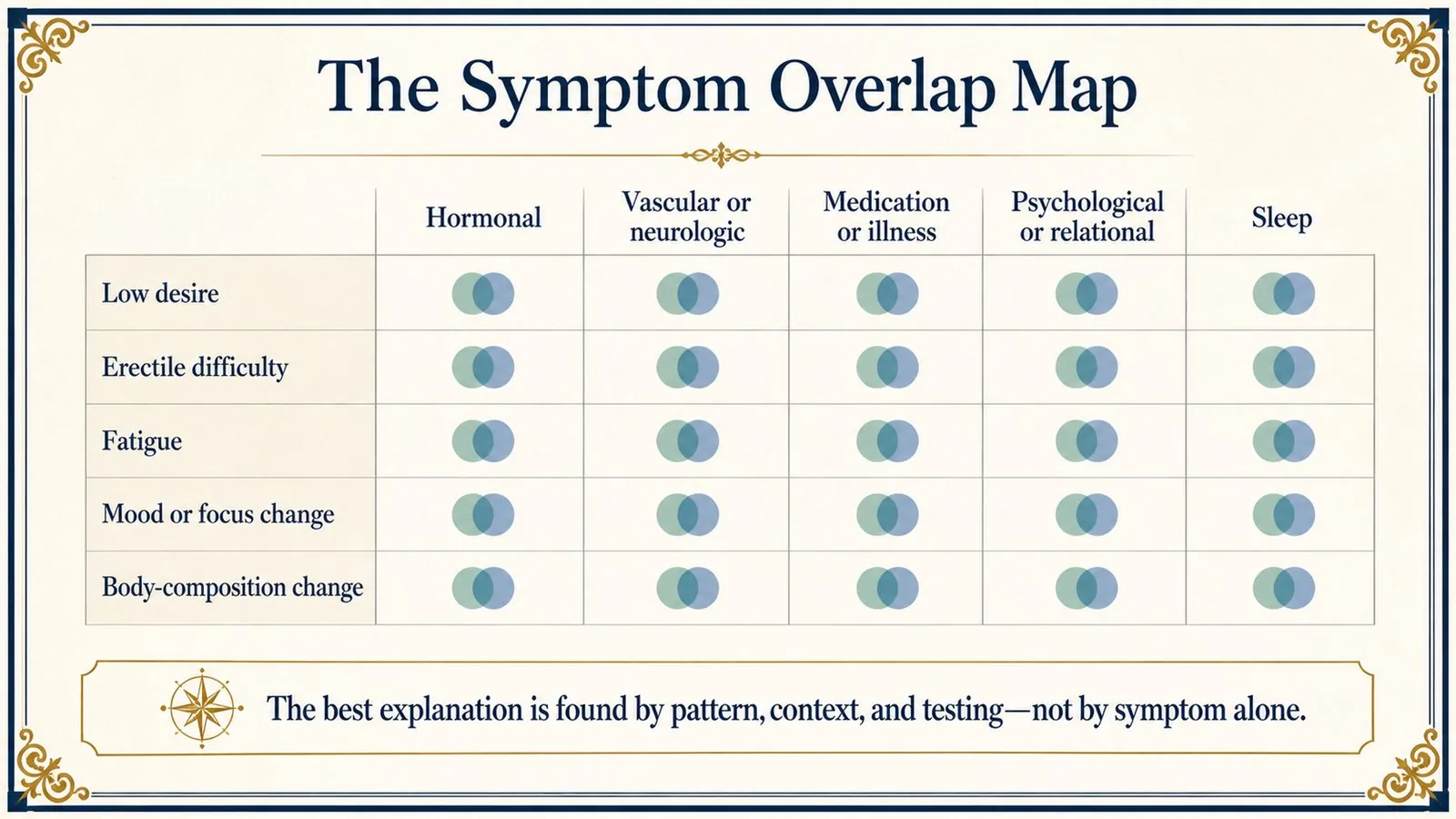
- The same five symptoms can come from sleep, mood, vascular, medication, metabolic, or hormonal causes, and several often coexist.
- Every symptom word is translated into a description with a timeline; what changed first carries more weight than the list.
- Desire and erections are different systems; testosterone does not hold an airway open and is not a memory aid.
- Tests answer named questions in priority order, with dangerous findings never waiting behind an optimization panel.
- The differential stays open after treatment starts so that new problems are not misread as a need for more testosterone.
Connected Symptoms Do Not Prove a Hormonal Cause
When a man tells me five things have gone wrong at once, he is probably correct that they are linked, but not yet about what links them. Tiredness, less desire, unreliable erections, a thicker waist, and poor focus can come from sleep apnea, depression, cardiometabolic disease, a medication, alcohol, chronic pain, anemia, thyroid disease, trouble in a relationship, confirmed hypogonadism, or some combination of those. I will not blame the hormone until the other candidates have had their hearing.
That hearing is the differential diagnosis. It asks which explanation accounts for the timing, pattern, preserved functions, exam, and labs with the fewest assumptions. It is not a tournament testosterone has to lose. A man may have both androgen deficiency and vascular erectile dysfunction, or both sleep apnea and depression. The aim is to stop asking one diagnosis to explain more than the evidence permits.
Replacing Labels With Descriptions
"Fatigue" might mean sleepiness, weakness, breathlessness, no motivation, poor exercise tolerance, or slow recovery, and each implicates a different system. "Low libido" might mean fewer spontaneous sexual thoughts, less inclination to initiate, or avoidance driven by unreliable erections. "Brain fog" might mean distractibility, slow recall, daytime drowsiness, sedation from a drug, or genuine cognitive decline.
My rule is easy to state and hard to keep: no symptom word stands until it has become a description with a timeline. If a man says he is exhausted, I want to know whether he could nod off this minute and whether a week away lifts it. If his drive has vanished, I want to know whether sexual thoughts still occur and whether that shifts with partner, stress, or sleep. I ask which change came first, because sequence carries more weight than any checklist. I record what still works as carefully as what does not, and I go through his medications by mechanism, asking plainly and without judgment about opioids, steroids, and performance products. Only then do I look at the testosterone number, which by then rarely stands alone.
Desire Is Not the Same as Erection
Sexual complaints track more closely with low testosterone than general ones, so their presence makes careful hormone testing more worthwhile. Even so, desire and erectile mechanics are assessed separately. Producing an erection requires intact nerves, healthy vessels, relaxed smooth muscle, adequate stimulation, and a context that allows arousal. Atherosclerosis, diabetes, hypertension, pelvic surgery, medications, and performance anxiety all undermine erections while leaving desire intact. Sequence helps: when desire fades first, confidence in erections follows, whereas early mechanical failure teaches a man to avoid sex, and later he reports low desire. On a questionnaire those two men look identical.
Tiredness, Sleepiness, Mood, and Thinking
Fatigue is a frequent feature of testosterone deficiency and of nearly everything else. Sleepiness deserves its own attention because men relabel it as low energy. Heavy snoring, breathing pauses a partner has witnessed, headaches on waking, getting up at night to urinate, and dangerous drowsiness during the day all point toward sleep-disordered breathing. Testosterone will not keep an airway open. Chasing sleepiness with a hormone postpones care for a condition with cardiovascular and safety consequences.
A testosterone level neither confirms nor rules out depression. Low mood drains desire, concentration, initiative, and confidence, and lingering symptoms drag mood further. In some men with confirmed deficiency, testosterone can shift mood slightly, but that is not a claim that it treats depression, and the trial data cap any suggestion that it sharpens cognition. I will not present it as a memory aid.
Weight, Illness, Drugs, and Circumstances
Men often offer weight gain as evidence of low testosterone, but the influence runs both ways and one snapshot cannot say which came first. Acute illness briefly depresses testosterone while causing tiredness and lost interest, so a sample drawn during a fever or early recovery records a stress response, not a baseline. Opioids suppress the axis in some men, and drugs that elevate prolactin dampen the signal from the brain. Anabolic steroids and unprescribed performance products suppress LH, FSH, native testosterone, and sperm production, which is why I ask about them plainly. Alcohol, night shifts, and caregiving impose physiologic stress with no diagnosis code.
Constructing and Testing the List
A good differential opens with a precise summary, then ranks. Common explanations matching the timeline go first, alongside anything dangerous to miss: a new lump in a testicle, a change in peripheral vision, a severe headache with pituitary features, marked anemia, or heart or lung symptoms are never queued behind an optimization panel.
- A repeat morning testosterone tests whether the low reading persists.
- SHBG and free testosterone help when the findings conflict with one another.
- LH and FSH place a confirmed low value within the axis; prolactin investigates one particular secondary pattern.
- A sleep study looks at breathing overnight.
The list never closes. If treating sleep resolves drowsiness but desire and testosterone stay low, the androgen question advances. If testosterone reaches target and erections are still unreliable, vascular, neurologic, medication, and situational factors advance instead of a reflexive dose increase. I set the endpoint before the first dose and keep the differential alive afterward, because a man on testosterone can still develop anemia, depression, or thyroid disease for unrelated reasons. The same habit guards against the reverse mistake, where everything is blamed on aging and nobody tests despite a pattern that fits hypogonadism.
Common questions
Can low testosterone cause fatigue and brain fog?
Fatigue turns up often in testosterone deficiency, but it turns up often in nearly every condition. Short or fragmented sleep, sleep apnea, depression, anxiety, anemia, thyroid disease, infection, chronic pain, medications, and substance use all belong in the first pass. Sleepiness specifically points toward sleep-disordered breathing, which testosterone does not treat, and the trial evidence caps any claim that it sharpens thinking.
Is my erectile dysfunction caused by low testosterone?
Not necessarily. Testosterone supports desire and some elements of sexual function, but an erection also depends on intact nerves, healthy vessels, relaxed smooth muscle, enough stimulation, and a context that allows arousal. Atherosclerosis, diabetes, hypertension, pelvic surgery, nerve disease, medications, and performance anxiety can all undermine erections while desire stays strong. The order in which things changed helps tell the mechanisms apart.
Which tests should be done before starting TRT?
Each test should answer a named question. A repeat morning testosterone asks whether the low reading persists. SHBG and free testosterone help when results conflict. LH and FSH place a confirmed low value within the axis, prolactin investigates one specific secondary pattern, and a sleep study looks at breathing overnight. Ordering everything with no question in mind mainly increases the odds of stray findings.