
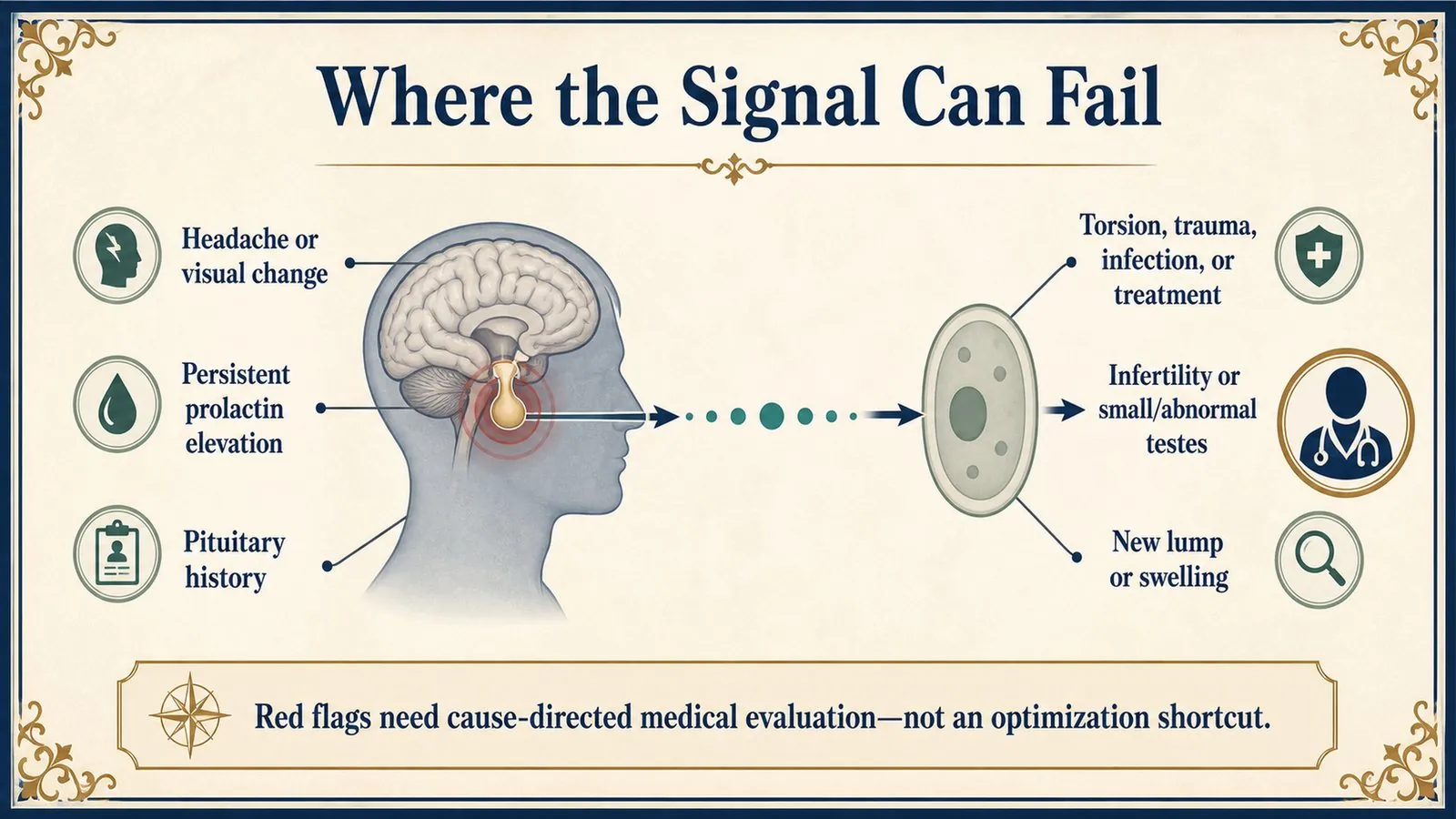
- Low testosterone with high LH points to the testes; low testosterone with low or normal LH points to signaling from the brain, but neither pattern is a final diagnosis.
- Prolactin is tested when LH is low or low-normal; a normal prolactin does not rule out a pituitary lesion.
- I order pituitary MRI selectively, weighted most heavily by the AUA criterion of total testosterone below 150 ng/dL with low or low-normal LH.
- I examine the testes myself and use in-office ultrasound in the same visit when I feel a lump, small testes, or a varicocele.
- A new persistent scrotal change, sudden severe scrotal pain, or new vision loss gets evaluated first; testosterone treatment is never a test for whether a symptom improves.
A low result rarely means a pituitary tumor, and a headache rarely means one either. Yet some hypogonadism comes from structural, genetic, or treatment-related disease, and replacement in those men fixes the lab value while the disease sits unseen. My task is to pick out the uncommon cases where delay is costly, not to alarm every man with a low number.
Find Where the Axis Failed
The chain runs hypothalamus to pituitary to testes: the pituitary puts out LH and FSH, and the testes answer with testosterone and sperm support. A break can occur at any link. High LH alongside low testosterone points to testes that are not responding; LH that is low, or normal when it ought to be elevated, points to weak signaling from above. Neither pattern is a diagnosis by itself, and prior anabolic steroid use, which shuts down LH and FSH by design, can blur the two.
Severity raises my attention without telling me why: a markedly low confirmed value is hard to blame on fluctuation, yet it does not establish a mass or permanent damage. Timing matters as much. Unfinished puberty or undescended testes lead down one road; symptoms that began abruptly after a head injury lead down another. I also note what still works, since intact pituitary function, no visual complaints, and a normal prolactin ease my concern without excluding a lesion.
The Pituitary and the Role of Prolactin
The pituitary hangs beneath the brain, just under the visual pathways, and directs several hormone systems. My concern climbs when low testosterone with low or normal LH is joined by elevated prolactin, a change in vision, a severe headache that is new, multiple abnormal pituitary hormones, or a known disorder of the gland. Since it also governs adrenal, thyroid, growth hormone, and water balance, checking testosterone alone may be insufficient when the gland itself is the problem.
Sustained high prolactin dampens GnRH signaling; a pituitary tumor can cause that, as can medications, an underactive thyroid, kidney disease, and physical stress. The AUA recommends measuring prolactin whenever low testosterone comes with low or low-normal LH. A single modest elevation does not identify the cause, and a normal prolactin does not clear the gland, because a lesion can interfere with gonadotropin output without touching prolactin.
Choosing Pituitary MRI
I order pituitary MRI deliberately, not as an automatic companion to every low result. The AUA criterion I weigh most heavily is total testosterone under 150 ng/dL with low or low-normal LH, which justifies MRI even if prolactin is normal. That cutoff steers the workup. It does not mean a value under 150 equals a mass, and no man should treat it as a personal emergency flag.
Beyond that criterion I consider the confirmed values, the LH pattern, prolactin, the other pituitary axes, headache or visual symptoms, and prior disease or treatment. I will not image a man because one low number scared him; small pituitary abnormalities are common enough that a scan can turn up a chance finding. New vision loss, double vision, a severe new headache, or evidence of broad pituitary failure needs prompt attention; a stable, symptom-free pattern is evaluated at a more measured pace.
The Testes and Why I Examine Them
Primary testicular failure can start in the womb, during development, or after decades of normal function; genetic syndromes, undescended testes, torsion, injury, infection, chemotherapy, and radiation are all causes. A puberty history with limited genital development, breast tissue growth, or longstanding infertility may justify genetic testing, though none alone confirms a syndrome.
This is where I diverge from a labs-only visit, and it is my own standard rather than a guideline mandate. I do the testicular examination personally, and in my office the ultrasound probe extends that exam instead of being a separate referral. Small, firm testes point toward one family of disorders; asymmetry, an absent testis, tenderness, or a new focal change points toward another. If I feel a lump, small testes, or a varicocele, I scan during that same appointment, because no blood panel can rule a mass in or out.
Most scrotal lumps are benign, so I do not teach with fear. The proportionate message is that any new, persistent change gets checked, since benign and dangerous conditions look the same without an examination. Testosterone is never a trial to see whether a lump-related symptom fades, and sudden severe scrotal pain is never observed at home, because saving the testis is a race against the clock. Sometimes infertility is the first clue to testicular or central disease, since sperm production can fail before testosterone drops far enough to produce symptoms. A very abnormal semen result with high FSH or small testes should broaden the search for a cause, not prompt a testosterone trial that suppresses sperm even more.
Living With an Unnamed Cause
A thorough evaluation sometimes ends without a named disease. The word idiopathic documents that gap; it explains nothing and does not license me to stop looking. Treatment can still be appropriate when the diagnosis is solid and the risks, fertility plans, and alternatives have been talked through, but the unexplained cause stays on the record so new symptoms reopen the question. I stop testing once the likely causes and high-stakes alternatives are covered, and I document my reasoning for whoever sees him next.
Because these diseases are rare, red-flag care is targeted. Rarity does not make it optional.
Common questions
Does low testosterone mean I have a pituitary tumor?
Nearly always, no. The vast majority of men with low testosterone have no pituitary tumor, and most headaches have nothing to do with one. My concern rises when low testosterone with low or normal LH appears together with elevated prolactin, a change in vision, a severe new headache, or several abnormal pituitary hormones. That combination calls for a wider evaluation rather than a prescription for testosterone alone.
When is a pituitary MRI needed for low testosterone?
I choose it case by case rather than ordering it for everyone. The AUA criterion I weigh most heavily is a total testosterone under 150 ng/dL with low or low-normal LH, which justifies MRI even if prolactin is normal. I also factor in the confirmed values, prolactin, the other pituitary axes, headache or visual symptoms, and prior disease. A single frightening number is not a reason to scan, because incidental pituitary findings are common.
Why does a urologist examine the testicles before prescribing testosterone?
A blood panel cannot rule a mass in or out. Size and texture carry information: small, firm testes point toward one family of disorders, while asymmetry, tenderness, or a new focal change points toward another. If I feel a lump, small testes, or a varicocele, I scan with ultrasound during the same appointment. Any new, persistent change gets evaluated, and testosterone is never used as a trial to see whether a lump-related symptom fades.