
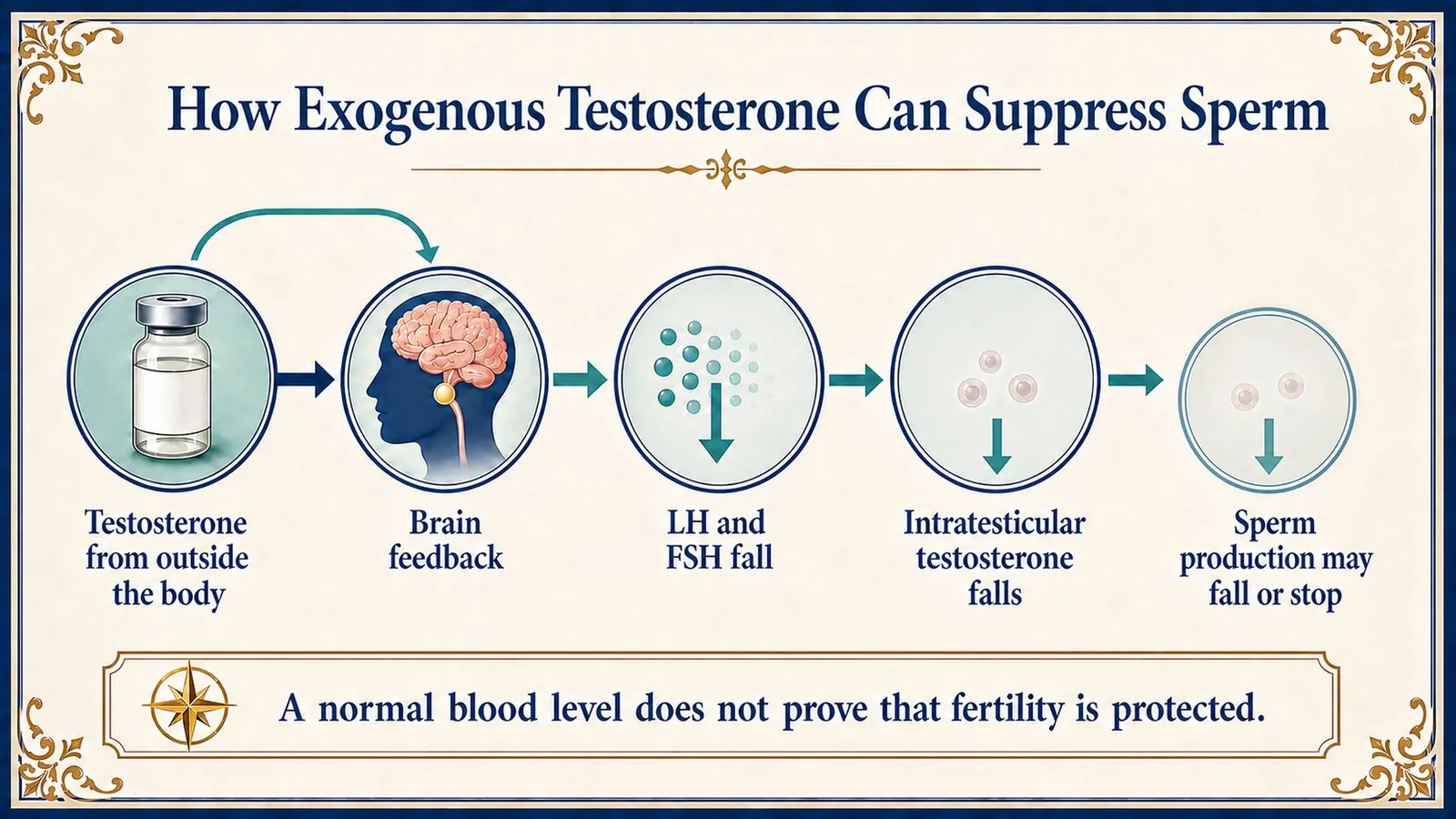
- Prescribed testosterone signals the brain to cut LH and FSH, so sperm production can fall sharply while the blood level looks normal.
- Major urology and reproductive guidance advises against exogenous testosterone for men interested in current or future fertility.
- Suppression is neither reliable birth control nor automatic permanent sterility; recovery is common but variable and cannot be promised.
- A baseline semen analysis and sperm banking preserve options, but no result makes TRT "fertility safe."
- I tell every man, before discussing benefits, that testosterone can switch off his sperm, and I revisit the question as his life changes.
When a man comes in for energy rather than a baby, my question about children can sound like a distraction. It is not. A testosterone prescription alters the very system he may want later, and protecting his options is far simpler before suppression than after. Later is costly; now takes one conversation and one sample.
Putting fertility first means his present, future, and undecided reproductive goals are settled before any exogenous testosterone is prescribed. It does not mean every man must freeze sperm or decide his family plans on the spot. "I'm not sure" is a valid answer, and it gets a plan that keeps options open wherever reasonably possible.
The Mechanism of Suppression
Pituitary LH drives testosterone production within the testes, and FSH, together with a local testosterone concentration far above anything measured in blood, keeps the sperm-producing tubules running. When testosterone comes from a prescription instead, the brain reads the circulating level as a cue to cut LH and FSH. The blood test then looks fine while intratesticular testosterone drops and sperm output falls sharply.
This is why exogenous testosterone is not a fertility treatment, and why major urologic and reproductive guidance recommends against prescribing it to men who want children now or later. The degree of suppression is unpredictable: some men become azoospermic, with no sperm in the ejaculate, while others keep a reduced count, and neither the blood level nor prior fatherhood forecasts which. Suppression is neither dependable contraception, since pregnancy can occur if any sperm persist, nor guaranteed permanent sterility. Recovery after stopping is common, but its timing varies and cannot be guaranteed, particularly after years of use, preexisting infertility, or added anabolic-drug exposure.
More Than Yes or No
My opening question is whether having a biological child would matter to him if the circumstances lined up. Then I ask about timing, because the honest categories are trying now, probably within a few years, maybe someday, genuinely undecided, and firmly not wanted after thoughtful consideration. A couple already trying to conceive loses more from months of waiting on recovery than a younger couple with no schedule.
Having fathered a child before does not prove fertility today; sperm production shifts with age, illness, medications, heat, varicocele, cancer treatment, and anabolic drugs. I am not pushing anyone toward parenthood; I only need to know whether keeping biological options open has value to him. After an informed conversation, a man may choose a treatment that could suppress sperm; his autonomy is respected by disclosing the mechanism, not by hiding it.
Documenting a Baseline
A semen analysis records sperm production before treatment begins, though it is not a guarantee of fertility. Results fluctuate, and an abnormal first sample usually needs a repeat. It is most useful when it could alter the decision: a man with a low count might decline exogenous testosterone, consult a specialist, or bank sperm first. A normal analysis does nothing to prevent later suppression, so it never makes TRT "fertility safe." The error to avoid is not skipping a universal testing package; it is letting a man take on a fertility risk nobody explained to him.
Freezing sperm is well established, but it preserves a chance rather than a pregnancy, since outcomes also hinge on sample quality and both partners' circumstances. Banking deserves consideration when biological parenthood matters and treatment may suppress sperm, especially when baseline production is limited or a prolonged recovery would carry serious consequences. Biological parenthood is not the only route to a family; my job is to make the reproductive effect visible, not to favor one kind of family.
Matching the Treatment to the Goal
"Low testosterone treatment" is an umbrella over therapies with different reproductive effects. Certain supervised options act on the body's own signaling instead, but they hinge on the diagnosis: in primary testicular failure, stimulating a failing organ may restore neither testosterone nor sperm, whereas in a secondary pattern the testes may still be able to respond.
hCG mimics LH at the testis and is approved for selected forms of hypogonadotropic hypogonadism; using it alongside TRT to preserve sperm, or afterward to help recovery, is generally off label. Clomiphene boosts pituitary signaling in some men with a secondary pattern but carries no FDA approval for male hypogonadism or infertility, and enclomiphene has no approved product at all. Nasal testosterone showed less semen suppression in small, selected studies that reported no pregnancy outcomes, and its label still warns that androgens can suppress sperm. Those caveats are why none of them earns the label "fertility safe."
What I Say Before the First Prescription
Fertility first is my rule ahead of any initial prescription, and I apply it more strictly than the guidelines do, because the guidelines speak to men who want children and I speak to every man, including the ones certain they do not. My sentence is short and precedes any mention of benefits: testosterone can shut off your sperm. Recovery after stopping is often possible, but it can take months or longer, it cannot be guaranteed, and no blood value or add-on drug proves your sperm are protected. I will not write a first prescription for a man who has not heard that, and I do not accept "we'll deal with it later" from anyone, myself included. The question comes back as life changes; an answer at thirty is not final.
Common questions
Does testosterone therapy make you infertile?
It can shut down sperm production for as long as it is used, sometimes to the point of no sperm in the ejaculate and sometimes to a lower count. That is why major guidance recommends against prescribing it to men who want children now or in the future. Recovery after stopping is common but unpredictable and cannot be guaranteed. Suppression is neither guaranteed permanent sterility nor dependable contraception.
Should I do a semen analysis before starting TRT?
It is most worthwhile when the result could change your decision. A low count might prompt you to decline exogenous testosterone, see a male-reproductive specialist, or bank sperm first. It is a single sample, results fluctuate, and an abnormal first test usually needs a repeat. A normal result does nothing to prevent later suppression, so it never makes TRT fertility safe. The real error is taking on a risk nobody explained to you.
Is there a fertility-safe alternative to testosterone?
None deserves that description. hCG is approved for selected forms of hypogonadotropic hypogonadism but is generally off label when used with or after TRT. Clomiphene has no FDA approval for male hypogonadism or infertility, and enclomiphene has no approved product. Nasal testosterone showed less semen suppression in small studies, yet its label still warns that androgens can suppress sperm. The effect on sperm must be measured rather than assumed.