
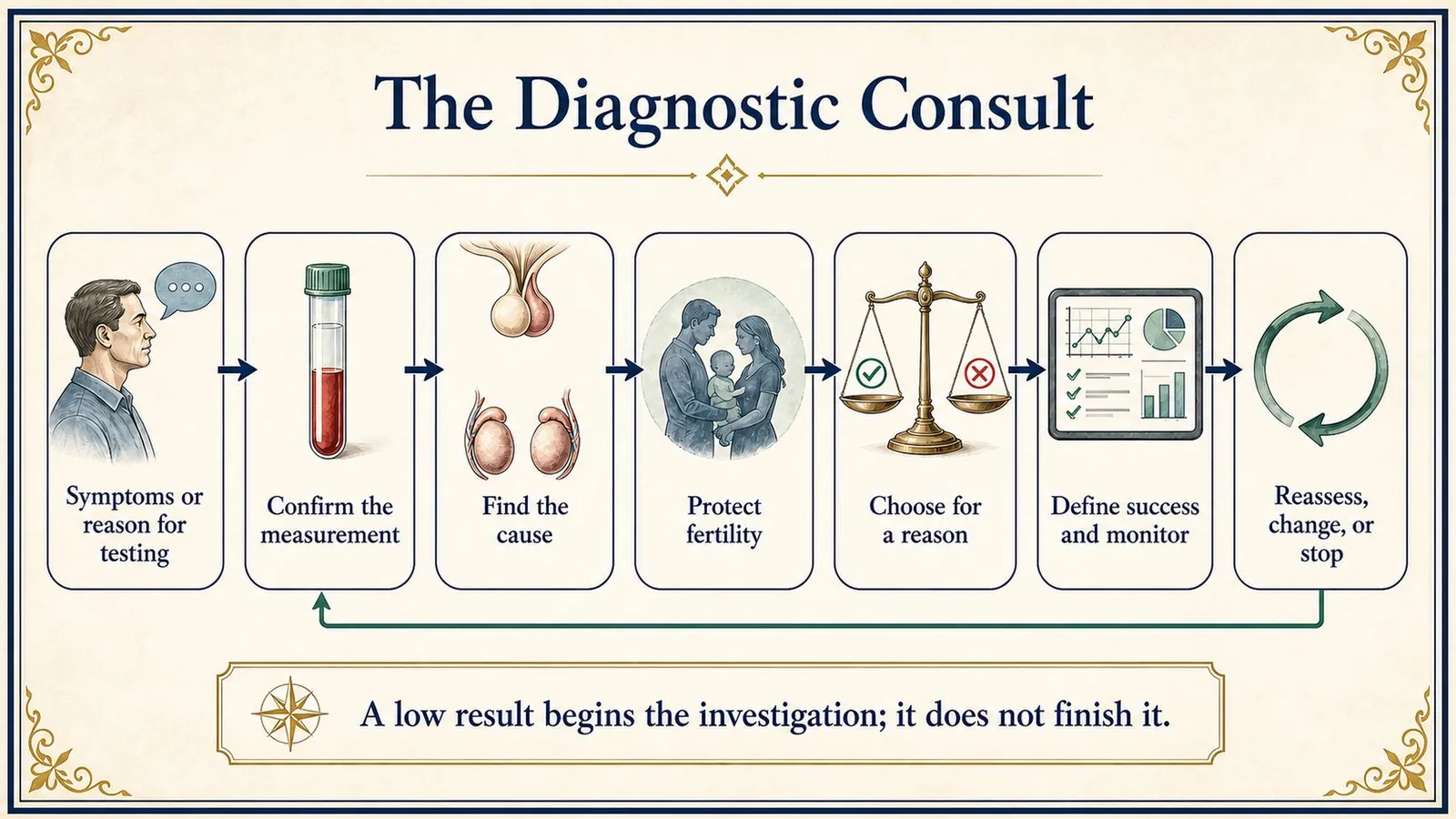
- A low testosterone result is a starting point, not a diagnosis; hypogonadism requires compatible symptoms plus consistently low morning values.
- Desire, erections, fatigue, and body composition each have many causes, and several diagnoses can coexist.
- Replacement means treating a documented deficiency, not pushing a value toward the top of the range.
- Prescription testosterone suppresses sperm production, so fertility is discussed before the first dose, not after.
- A real consult follows seven linked decisions from symptom to reassessment, and every step is explainable.
A Flagged Result Is Where the Work Begins
By the time a man sits down in my office, he has usually already stared at a red value on a lab portal, and that value has absorbed every frustration he carries. I understand why: his symptoms are genuine, and a number looks more fixable than a complicated life.
What the number cannot do is answer the questions I ask first. When was the sample drawn, and had he eaten, slept, or been sick? Would a second draw also be low? Does it reflect usable hormone or a shift in carrier protein? Hypogonadism is not a lab flag plus unhappiness. To defend the diagnosis I need fitting symptoms or signs paired with testosterone that stays low on repeat, run by a suitable assay under the right conditions. That is why every major guideline calls for a repeat early-morning sample, and why I will not skip it. A decision that may last years should not rest on one unrepresentative value.
Two confirmed results still need reading. Circulating testosterone travels mostly bound to SHBG and albumin, so an unusually high or low SHBG makes the total misleading about what is free to act. The value also sits in a control loop: pituitary LH and FSH, testicular testosterone and sperm. Low testosterone with high LH means something quite different from low testosterone with low LH.
Why Symptom Lists Mislead
Reduced sexual desire has the most credible link to low testosterone, but desire has never answered to one hormone alone. Depression, anxiety, relationship strain, pain, medication, lost sleep, substance use, and chronic illness all move it. Erection problems are misattributed even more often, since an erection requires blood supply, nerve signaling, smooth-muscle relaxation, stimulation, freedom from interfering drugs, and the right psychological setting. Tiredness and mental fog are the least specific complaints of all, and body composition is a feedback loop, not a downstream effect. My first job is not to sort a man into "hormonal" or "not hormonal." It is to notice which features travel together, which came first, which functions are intact, and whether the labs back up the proposed mechanism. More than one diagnosis can be true at once.
Replacement Versus Optimization
Replacement therapy is what it sounds like: supplying testosterone to a man whose own production has fallen short in a way that matters clinically. The aim is to restore, not to push as high as possible. "Optimization" relocates that target. It assumes the top of the reference range is better by definition, declares victory when the number climbs even if the man feels no different, and treats every alternative explanation as an obstacle. When I say diagnosis before optimization, I am correcting that drift, not arguing against feeling better.
This matters because starting TRT is not a harmless experiment. Outside testosterone shuts down the body's own output and, with it, sperm production. It can push hematocrit up, shift blood pressure, move PSA, aggravate fluid retention or certain urinary complaints, and commit a man to ongoing labs and expense. The drug is not exceptionally risky, but "let's just try it" needs a starting baseline, a stated goal, a set observation window, safety checks along the way, and an agreed plan for when the hoped-for benefit never shows up.
Fertility Comes First, Not Last
Men are rarely asked about children until the topic is urgent, because they came in about energy or sex. I bring it up before any first dose, whatever the man's age or relationship status. Exogenous testosterone suppresses the signals the testes need to make sperm, occasionally all the way to azoospermia, meaning the ejaculate contains none. That suppression is unpredictable: it cannot be trusted as birth control, and it cannot be assumed away either, since a normal testosterone level says almost nothing about sperm count. Most men recover after stopping, but the timeline varies and no one should be promised a date. If a child matters now or might later, a baseline semen analysis, sperm banking, and supervised options that preserve the man's own signaling belong in the conversation before treatment, not after.
How the Consult Is Structured
I work through seven connected decisions. Begin with the symptom or whatever prompted the test. Establish that testosterone is truly and consistently low. Identify the pattern and search for a believable cause. Safeguard fertility before anything suppresses it. Pick treatment, or an alternative, for a stated reason. Spell out what success looks like and watch for harm. Finally, revisit, adjust, or stop once the evidence in that man no longer justifies the plan.
Wanting children reshapes the workup, elevated hematocrit postpones treatment, and a new pituitary symptom returns me to localization. None of this means endless testing; sensible diagnosis is proportionate: reversible contributors get addressed, warning signs get escalated, and an obvious organic cause can make the route short.
The man who arrived with one flagged value may leave on TRT. He may instead treat sleep apnea, swap a medication, get care for depression, or learn his pituitary is the problem. He may need several of those; no portal shows any of them. Whatever the destination, he should know how he got there: what the tests proved, what is still unknown, how fertility was handled, what treatment should improve, what will be tracked, and when the decision gets reviewed. That is the difference between a hormone transaction and a medical consultation.
Common questions
Does one low testosterone test mean I have low T?
No. To call it hypogonadism I need symptoms or signs that fit, plus testosterone that stays low on repeat testing done under the right conditions. Levels swing across the day and drop with illness, poor sleep, and physical stress, which is why the guidelines require a second early-morning sample before anyone is labeled. A single flagged result is something to confirm, not a diagnosis.
What is the difference between testosterone replacement and optimization?
Replacement supplies testosterone to a man whose body has stopped making enough in a clinically meaningful way. Optimization assumes the top of the reference range is automatically better and counts a rising number as success even when symptoms stay put. I treat a documented deficiency toward outcomes we define in advance; I do not chase a lab value for its own sake.
Should I think about fertility before starting TRT?
Yes, and before the first dose rather than after. Outside testosterone shuts down the signals needed for sperm production, sometimes to the point of no sperm at all. The degree of suppression is unpredictable, so it is not contraception, a normal blood level says nothing about sperm count, and recovery after stopping cannot be scheduled. If children may matter, a semen analysis and sperm banking come first.